
The Reporting Layer: Transparency in AI Usage
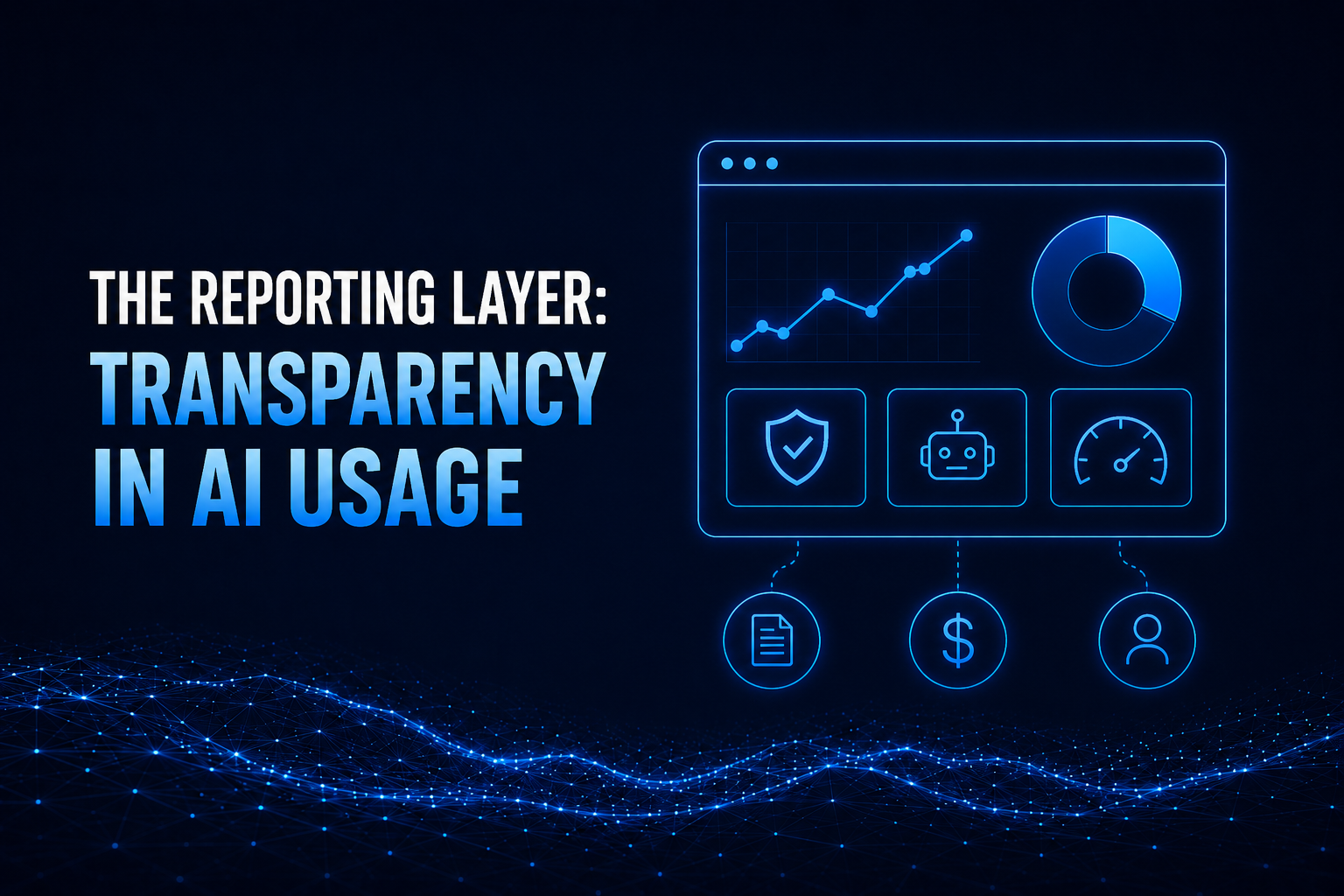
Every layer beneath this one generates records. Enforcement logs decisions. Metering counts events. Settlement records payments. Entitlement tracks standing rights. On their own, those records are scattered evidence. The reporting layer is what assembles them into a coherent, readable account that a content owner can inspect and an AI company can verify. It is the difference between a system that works and a system whose workings anyone can actually see.
This layer is easy to underrate because it does not grant access, move money, or enforce a rule. It produces visibility. But visibility is not a cosmetic feature in a monetization system. It is the basis of trust between parties, the mechanism for resolving disputes, and the feedback that lets an owner make informed decisions. Without reporting, the other layers form a black box that both sides are asked to trust blindly, which is precisely the condition that makes markets fail.
The need is acute right now because most content owners cannot see what AI systems are doing with their content. Machine access has largely been a blind spot, happening quietly in the background, invisible to the analytics tools built for human visitors. The reporting layer exists to close that blind spot, turning machine access from something that happens unobserved into something an owner can measure, understand, and act on.
What the reporting layer does
The reporting layer is the part of the stack that collects the records produced across the system and presents them in a usable, verifiable form.
Its job is to answer a set of concrete questions that an owner otherwise cannot: which AI systems accessed the content, how often, which specific pages or resources they touched, whether each request was allowed or blocked, what was metered, and what was settled. This is the core promise of usage reporting, the ability to know who requested what, from where, how often, and what was returned. Each of those facts exists somewhere in the system's records. The reporting layer is what surfaces them together, so the owner sees a complete picture rather than fragments scattered across logs.
The distinction that matters here is between raw records and reporting. A server log contains the underlying events, but reading raw logs is not the same as understanding activity. Reporting structures those events into something legible: activity grouped by AI provider, by type of bot, by section of the site, over time. The point is comprehension, not just retention. A pile of log lines proves a request happened. A report tells the owner what is actually going on, which is what makes a decision possible.
Why the source of the data matters
Not all usage data is equally trustworthy, and the reporting layer is only as reliable as the records it draws on. This is why where the data comes from is a substantive design question rather than a technical detail.
The most reliable reporting is built on server-side records rather than inferred signals. Analytics tools designed for human visitors run in the browser, which means they cannot see machine traffic that never executes their scripts. Reporting on AI access has to be grounded in what actually hits the infrastructure. Microsoft's approach to bot visibility makes the point explicitly: its data is drawn from real server-side logs collected through CDN integrations, rather than inferred or modeled behavior, which is what gives it a trustworthy view of automated access that client-side analytics simply cannot produce. Reporting built on guesswork produces guesses. Reporting built on the actual request stream produces facts.
This is also why the reporting layer depends so directly on the detection layer. A report that attributes activity to the wrong requester is worse than no report, because it presents false precision. If detection cannot reliably tell a genuine crawler from a spoofed one, the report inherits that uncertainty, and an owner making decisions on the basis of misattributed activity is being misled by their own dashboard. The quality of reporting is capped by the quality of the identification beneath it, which is why the two layers have to be built to work together.
Why reporting is what makes licensing verifiable
Reporting matters most where money and permission are involved, because a licensed relationship that cannot be verified is a licensed relationship built on trust alone. The reporting layer is what replaces that blind trust with evidence both sides can check.
Consider a licensing deal between a publisher and an AI company. Such agreements often specify terms about how frequently content may be scanned and which content may be accessed. Those terms are meaningless if neither side can confirm whether they are being honored. This is exactly the gap reporting fills. Cloudflare, for instance, lets publishers generate a report to audit the activity allowed under these arrangements, so that a deal on paper becomes a deal that can be measured against reality. Without that, a licensing agreement is a promise no one can check. With it, compliance becomes a matter of record rather than good faith.
The verification runs in both directions, which is what makes it valuable. An owner needs to confirm that access matched the declared policy: that search bots reached the content meant for discovery and that blocked training bots did not quietly slip through to restricted paths. An AI company needs to confirm that it was charged only for what it actually consumed. The metered record provides the underlying evidence, and the reporting layer is what makes that evidence legible to both parties. In a market where an agent and a content owner may transact without any prior relationship, this shared, inspectable account is what lets them trust the outcome, because both can point to the same report rather than arguing from separate assumptions.
Why measuring presence is not measuring value
A subtle but important limit of the reporting layer is that seeing access is not the same as understanding its consequences. Good reporting has to distinguish between the two, because conflating them leads owners to wrong conclusions.
Bot activity dashboards quantify presence: how many requests came from which AI systems and what they touched. That is necessary, but it is only the first signal in a longer chain. Access data reflects observed behavior and may not translate directly into traffic, attribution, or downstream outcomes. Knowing that an AI system crawled a thousand pages tells an owner about consumption, not about what that consumption was worth or what it cost them. A complete reporting picture has to connect access to consequence, which means relating crawl activity to referral traffic, to infrastructure cost, and to the value of the content consumed.
This is where reporting exposes one of the central problems this series has traced. The crawl-to-referral gap, the mismatch between how much AI systems consume and how little they return, only becomes visible once an owner can measure both sides of it. Analyses of Cloudflare's data have found some AI crawlers accessing on the order of tens of thousands of pages for every single referral they send back. An owner cannot see that imbalance, let alone act on it, without reporting that captures both the crawl volume and the return. This connects reporting directly to the scraping-to-revenue imbalance: the imbalance was able to grow precisely because it was invisible, and reporting is the layer that makes it visible enough to address.
Why visibility drives better decisions
The ultimate purpose of the reporting layer is not record-keeping for its own sake. It is to move an owner from guessing to deciding, because every meaningful choice about AI access depends on knowing what is actually happening.
An owner who cannot see machine access has only blunt options. They can allow everything, block everything, or guess. An owner with clear reporting can do something far more useful: identify which AI systems are consuming the most, which content is most sought after, where declared policy and actual behavior diverge, and where the highest-value machine access is occurring. That last point matters for monetization specifically, because a licensing strategy has to start from knowing where the valuable consumption is. Reporting is what turns a vague sense that "AI bots are hitting the site" into a precise map of who is taking what, which is the foundation for deciding what to charge for and what to permit.
This feedback function is also what lets the whole stack improve over time. Policy is not set once and left alone. An owner adjusts terms as they learn how their content is actually being consumed, tightening restrictions where value is leaking and opening access where it drives referral or revenue. That learning loop only exists if the system reports back. The policy layer declares the rules, but the reporting layer is what tells the owner whether those rules are working, which is what allows declaration to become an informed, evolving decision rather than a guess made in the dark.
The layer that makes the system accountable
The reporting layer is where a working monetization system becomes a transparent one. It gathers the records produced across policy, detection, enforcement, metering, settlement, and entitlement, and turns them into a clear account of what was accessed, by whom, under what terms, and for how much.
It matters because visibility is the foundation of trust, verification, and good decisions. Reporting built on reliable, server-side records lets an owner confirm that access matched policy and lets an AI company confirm it was charged fairly, which is what allows two parties with no prior relationship to trust the outcome. It distinguishes mere presence from real consequence, making visible the crawl-to-referral gaps and cost imbalances that would otherwise grow unseen. And it closes the feedback loop that lets an owner refine what they permit and price as they learn how their content is truly consumed. A monetization stack without reporting can still move money, but it cannot be trusted, audited, or improved, because a system no one can see into is a system no one can fully rely on.


