
The Policy Layer: Declaring Rights
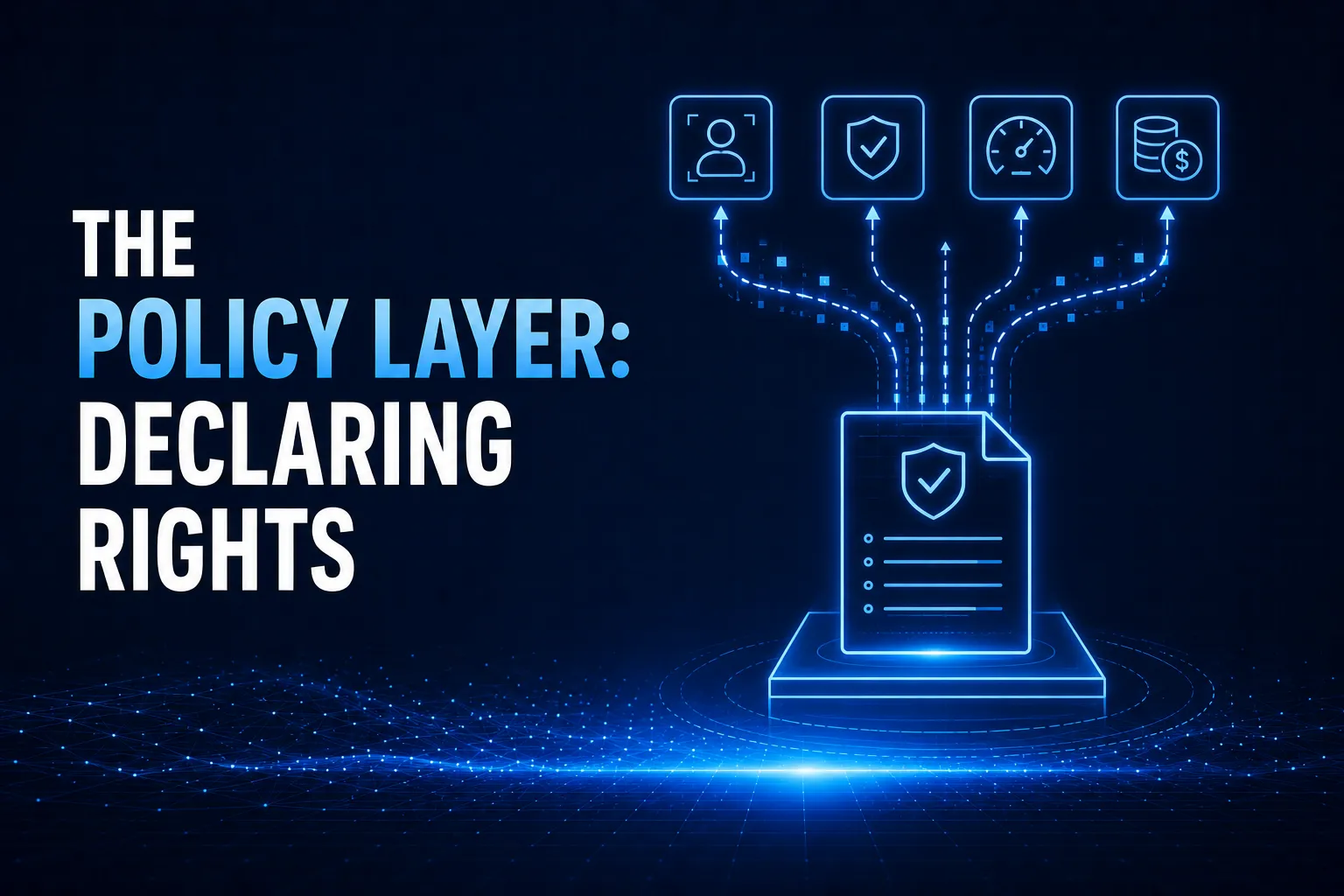
Every system that controls, meters, or charges for AI access has to start from the same place: a statement of what is allowed. Before a request can be evaluated, before usage can be metered, before payment can be triggered, there has to be a declared set of terms that says who may access the content, for which purposes, and on what conditions. That declaration is the policy layer.
The policy layer is the first layer in the AI monetization stack because it defines the rules that every layer above it enforces. Detection identifies the requester. Enforcement applies a decision. Metering records the event. Settlement triggers payment. All of those actions depend on a prior question: what does the content owner actually permit? Without a clear, machine-readable answer, the layers above have nothing to act on.
This matters now because AI systems consume content programmatically and at volume. A policy that lives only in a human-readable terms-of-service page cannot govern machine access, because the machine never reads it. The policy layer exists to translate intent into a format that software can discover, interpret, and act on at the moment of access.
What the policy layer is
The policy layer is the part of the stack where rights, permissions, and conditions are expressed in structured, machine-readable form.
A policy at this layer is not a contract written for lawyers. It is a declaration written for software. It states the things an automated system needs to know before it acts: which content is covered, which actors are permitted, which uses are allowed or prohibited, what limits apply, and what conditions attach, including price. The defining property is that the declaration can be read and evaluated by a machine without a human interpreting it first.
This is the layer that converts a content owner's intent into something operational. A publisher may intend to allow AI search indexing, permit licensed retrieval, charge for inference-time use, and prohibit training. That intent only becomes enforceable when it is expressed as a policy that software can parse. The policy layer is where that translation happens, which is why it sits beneath everything else. It is the source of truth the rest of the stack refers back to.
What a policy needs to express
A functional policy has to capture the distinctions that actually matter for AI access. A binary allow-or-deny signal is not enough, because machine use is not binary.
At minimum, a complete policy expresses several things. It defines the asset, the specific content or data the policy governs. It defines the permitted parties, distinguishing a search crawler from a training crawler, a licensed partner from an unknown agent. It defines the permitted and prohibited actions, separating indexing from retrieval, summarization from training, caching from transformation. It defines the constraints, including rate limits, retention windows, and allowed query types. And it defines the duties, including attribution requirements and, critically, the compensation that attaches to a permitted use.
That last element is what separates a rights declaration from a simple access control rule. A policy at this layer does not only say whether access is allowed. It says under what economic terms. This is the difference between machine-readable licensing and a basic crawler directive. One expresses economics; the other expresses only permission.
The expressiveness requirement is well understood in the standards world. The W3C's Open Digital Rights Language exists precisely to represent permitted, prohibited, and obligated actions over an asset, along with the constraints and duties that limit them. A duty in that model can include payment, which is what makes a rights-expression language a foundation for monetization rather than just access control. The media industry has already built on this foundation: IPTC's RightsML extends ODRL with geographic, time-based, and monetary constraints for news content, and is used by agencies including the Associated Press, Reuters, and Getty. The need for machine-readable rights expression is not new. What is new is the volume and the consumer, because the requester is now an AI system rather than a publishing house.
Why declared terms have to come first
It is tempting to think of enforcement as the important layer and declaration as a formality. That gets the dependency backwards. Enforcement cannot exist without a declared policy to enforce, because enforcement is the act of applying a rule, and the rule has to be stated before it can be applied.
Consider what happens without a declared policy. An AI crawler arrives at a site. The content owner has terms in mind, but those terms exist only as intent, perhaps written in prose on a legal page the crawler will never parse. The system has nothing structured to evaluate the request against. Its only options are to allow everything or block everything, because there is no policy that expresses the conditional middle ground. The absence of a declared policy collapses a market that needs gradients into a binary that serves no one well.
This is why the policy layer is the precondition for the rest of the stack. The coordination problem in AI content rights is partly a problem of declaration, because the market lacks a shared way to state terms that every system reads the same way. The scraping-to-revenue imbalance persists in part because terms are not declared in a form that can attach compensation to access. Declaration is the act that makes everything downstream possible. Get it right, and detection, enforcement, metering, and settlement have something to operate on. Skip it, and they have nothing.
Where the policy layer sits in the stack
The policy layer is the first of several interoperable layers that together make AI access governable and monetizable.
Above it sits the detection layer, which identifies what kind of requester is asking. Then the enforcement layer, which applies the policy decision by allowing, denying, rate-limiting, or routing the request to a paid path. Then the metering layer, which records the usage event. Then the settlement layer, which triggers payment when the metered event meets the policy's conditions. A reporting layer provides the audit trail across all of them.
Each of these layers refers back to the policy layer. The detection layer matters only because the policy distinguishes between actor types. The enforcement layer matters only because the policy defines what to enforce. The metering layer matters only because the policy specifies which events are billable. The settlement layer matters only because the policy attaches a price. The policy layer is the reference point the entire stack depends on, which is why it has to be expressive and unambiguous. An imprecise policy produces imprecise enforcement, inconsistent metering, and disputed settlement.
This dependency is also why programmatic licensing requires the policy layer to be machine-readable from the start. If the declaration is not structured, the connection between rights and runtime behavior breaks at the first step. The policy layer is where licensing stops being a document and starts being infrastructure.
Why declaration is hard to get right
Declaring rights in a way that works at machine scale is harder than it looks, for two reasons.
The first is expressiveness versus simplicity. A policy language has to be rich enough to capture real distinctions, such as the difference between indexing and inference, or between a licensed partner and an anonymous agent. But it also has to be simple enough that owners will actually adopt it and machines can reliably interpret it. A model that is too complex produces inconsistent interpretation across implementations, which undermines the interoperability that declaration is supposed to provide. A policy that two systems read differently is barely a policy at all. A model that is too simple cannot express the conditional terms that make a market possible. The design challenge is finding the balance.
The second is discoverability. A declared policy is useless if the requesting system cannot find it. The declaration has to live somewhere the machine will look, in a predictable location and format. This is why the most practical declaration approaches build on infrastructure that already exists. A standard that attaches to the file every site already serves is far more likely to achieve the adoption that makes declaration meaningful than one that asks the market to implement something entirely new.
These challenges are real, but they are challenges of design and adoption, not of feasibility. The policy layer is buildable today using standards that already exist. The work is convergence, not invention.
How we approach the policy layer
We treat the policy layer as the foundation of the entire system, because the rest of the infrastructure is only as good as the declaration it acts on.
Supertab Connect is built so that a content owner can define machine-readable terms once and have those terms drive everything downstream: identification, enforcement at the edge, metering, and settlement. The declaration is expressed using the open standards the market is converging on, including RSL, so that the policy is both expressive enough to capture real licensing distinctions and discoverable enough for automated systems to act on. The aim is to let an owner state what they permit and at what price, and to have that statement become operational without custom engineering.
The reason this matters is that a policy layer done well removes the need for the blunt instruments owners currently reach for. Instead of blocking all AI access because conditional terms cannot be expressed or enforced, an owner can declare a precise policy: discovery permitted, retrieval licensed, inference priced, training denied. That precision is only possible when the declaration layer is rich, machine-readable, and connected to the layers that enforce and settle.
The layer everything else is built on
The policy layer is where AI content rights become machine-readable, and it is the foundation on which every other layer of monetization infrastructure depends. It is the declaration of what an AI system may do with content, expressed in a form software can discover, interpret, and act on at the moment of access.
It comes first because it has to. Detection, enforcement, metering, and settlement are all acts of applying a rule, and the rule has to be declared before it can be applied. A market that wants to price AI access has to begin by stating terms in a structured, discoverable, machine-readable form, because rights that are only written for humans cannot govern access by machines. The policy layer is how a content owner's intent enters the system, and everything the system does afterward traces back to it.


