
The Scraping-to-Revenue Imbalance
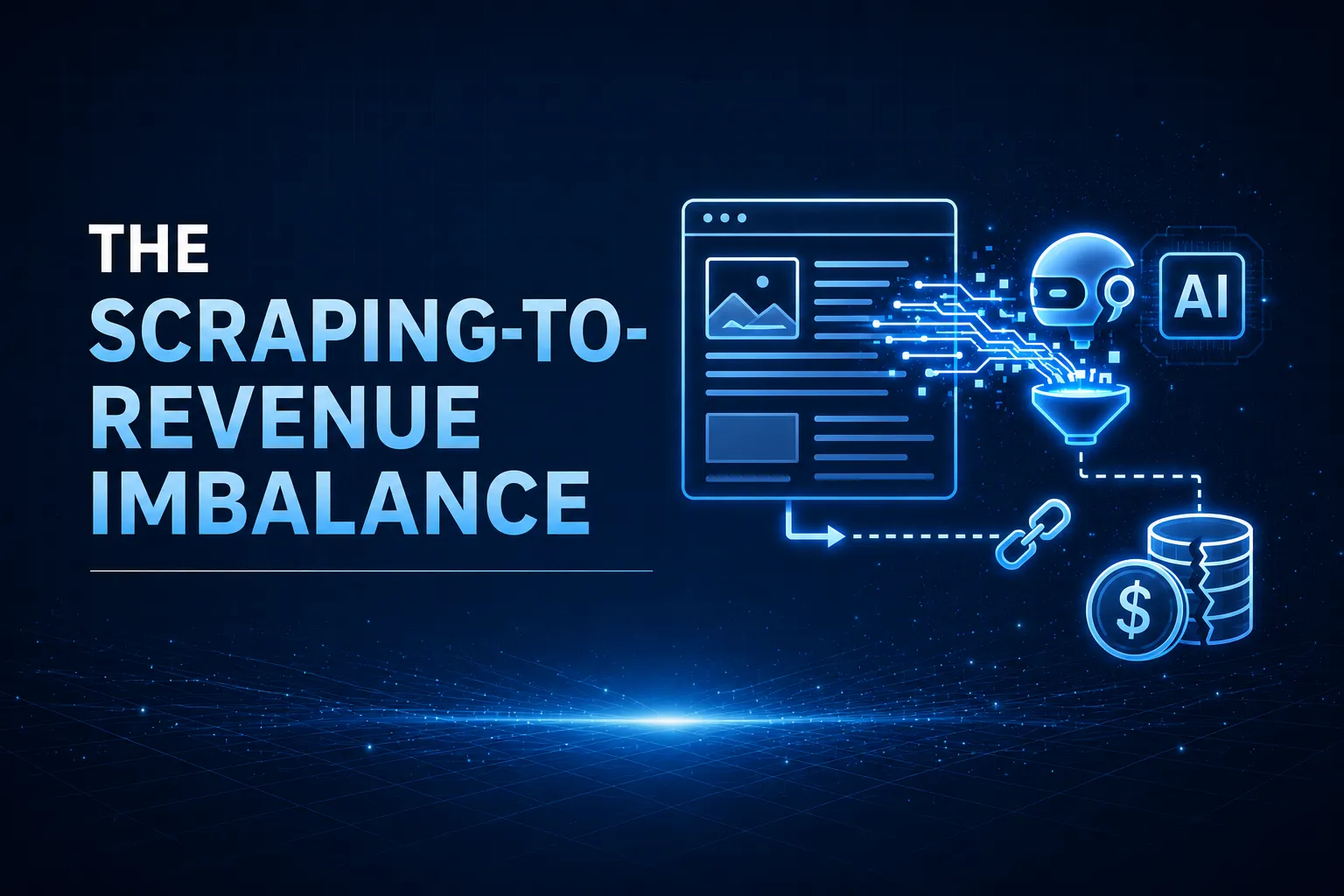
Content owners have always had to manage the tension between reach and revenue. More access to content is not automatically worth more money, and some forms of access have always generated less direct compensation than others. What is different now is the scale of the gap. AI systems are retrieving, processing, and generating value from web content continuously, and the economic path from that activity back to the people who created the content has largely not been built.
That is the scraping-to-revenue imbalance. It is not simply about unauthorised crawling. It describes a broader market condition in which machine consumption of content is growing quickly while the mechanisms that would connect that consumption to compensation are still catching up. The result is a form of economic asymmetry: the inputs are priced, the outputs are priced, but the content in the middle is often not.
What the imbalance actually describes
The scraping-to-revenue imbalance refers to the growing distance between the volume of AI-related content access and the revenue that access generates for publishers, data providers, and other content owners.
It is worth being precise about what counts as AI-related content access because the term covers several distinct behaviours. Large-scale training crawls, AI search indexing, retrieval-augmented generation, and runtime inference fetching are all forms of machine content access, but they create different downstream uses and different economic stakes. The imbalance applies across all of them, though with different intensities.
What they share is this: each one extracts value from content without a mechanism that reliably returns compensation to the owner. A training crawl ingests content to improve a model that will generate revenue through inference. An AI search index retrieves content to power a product that may reduce the user's need to visit the original source. A retrieval system pulls content at runtime to answer a query that the user would otherwise have searched for, clicked through, and generated advertising or subscription revenue on the original site. In each case, the content does real commercial work because it improves the product, trains the model, or satisfies the user, but the owner of that content is not in the transaction.
Why the old compensation mechanisms don't apply
Publishers and content owners were compensated indirectly under the search economy. Traffic flowed from search indexes back to source pages, where it could be monetised through advertising, subscriptions, or affiliate revenue. That model was imperfect, but it created a rough economic handshake: content fed discovery, discovery sent users, users generated revenue.
AI disrupts that handshake at both ends. On the access side, more than 50 percent of web crawl traffic now comes from AI bots and automated agents, exceeding human browsing for many publishers. On the revenue side, AI interfaces increasingly resolve queries without sending the user back to the source. The content is consumed, the user is satisfied, and the publisher receives neither the traffic nor the transaction.
Reuters Institute research on AI and journalism confirms that publishers are already feeling this pressure, with declining referral traffic from search identified as one of the most significant commercial concerns for news organisations heading into the AI era. The concern is well-founded because the substitution effect is real. When an AI interface answers a question, the click that would have followed a traditional search result often does not happen.
This is also why the imbalance cannot be solved simply by blocking bots. Blocking removes access, but it also removes any possibility of compensation. A publisher who blocks all AI crawlers protects their content from unpriced use, but they also opt out of a market that is forming around licensed machine access. The more useful question is not whether to block, but how to price.
The scale of uncompensated access
Precise industry-wide figures are difficult to establish because most AI content consumption happens without metering or reporting at the publisher level. But the direction of the data is consistent. Cloudflare's analysis of AI bot traffic found that AI crawlers are now among the most active automated clients on the web, with volumes that have grown rapidly alongside the deployment of large language models and retrieval-augmented systems. Publisher-side analytics firms have reported significant increases in non-human traffic that does not convert to pageviews, sessions, or any other metric that feeds existing monetisation systems.
The asymmetry is sharpest for publishers who produce content that AI systems actively seek out: original reporting, expert analysis, proprietary datasets, structured reference material, and high-quality long-form writing. These are also the categories where production costs are highest and where the economic argument for compensation is strongest. Because this content is valuable to AI systems, it is retrieved frequently. Because it is retrieved by machines rather than humans, it generates no advertising impressions, no subscription conversions, and no affiliate clicks.
The result is a cost structure that has not changed alongside a revenue structure that has deteriorated. The editorial team still exists. The servers still run. The content is still produced. But a growing share of its consumption is happening outside any economic model that returns value to the producer.
Why this is a market failure, not just a rights dispute
It is tempting to frame the scraping-to-revenue imbalance as a legal problem: a question of copyright, fair use, and terms of service. Those questions matter, and the legal landscape around AI training data remains genuinely contested, with major litigation ongoing in multiple jurisdictions. But framing the issue as purely legal misses the structural dimension.
Even in a world where every form of AI content access were to be legally permitted, the economic problem would remain. Permission is not compensation. A legal right to access content does not create a revenue path from that access back to the content owner. The imbalance exists because the market lacks the infrastructure to connect machine consumption to payment, not only because AI companies are accessing content without authorisation.
This is why the problem is a market design failure. The mechanisms that worked well enough when humans were the primary consumers of content do not work when machines are. Machines do not click ads. They do not subscribe. They do not generate the behavioural signals that advertising attribution systems depend on. A market built around human consumption will systematically undercompensate content owners once machine consumption becomes the larger share of access.
What a compensated access path requires
Closing the scraping-to-revenue imbalance requires connecting three things that currently operate independently: declared licensing terms, enforced access control, and metered payment.
Declared terms are the starting point. A content owner cannot be compensated for machine access if the terms under which access is permitted are not expressed in a form machines can find and interpret. This is the role that machine-readable licensing and standards like RSL are designed to play. RSL allows publishers to assert ownership and publish licensing terms in a structured format that automated systems can discover, evaluate, and act on. Without declared terms, every access decision defaults to ambiguity.
Enforced access control is what makes declared terms operational. A policy that exists only on a terms-of-service page does not prevent unpriced access. Enforcement has to happen at the point of content delivery, at the CDN or server layer, where access requests can be evaluated against licensing status before content is returned. This is what AI access control infrastructure is designed to do: evaluate the requester, check their licensing status, and route the request accordingly.
Metered payment is the final layer. Once access is governed by declared terms and enforced at the delivery layer, usage can be recorded and billed. That may mean per-crawl fees, per-retrieval charges, flat licensed access for specific AI use cases, or threshold-based billing that aggregates events before triggering settlement. The right model depends on the content type and the access pattern, but the infrastructure requirement is consistent: usage has to be measured before it can be priced.
Why the opportunity is larger than the enforcement problem
It is worth separating the enforcement case from the revenue case, because they point in different directions strategically.
The enforcement case says: stop uncompensated access. Block crawlers. Send legal notices. Assert rights. This is a defensive posture, and it has real value in protecting content from uses the owner has not consented to.
The revenue case is more commercially significant. AI companies are actively looking to license quality content for training, search augmentation, and generation. The question is whether publishers are positioned to transact when those conversations happen. A publisher with no machine-readable licensing terms, no enforcement infrastructure, and no metering capability cannot participate in that market, even if they want to.
This is why becoming transaction-ready matters more than becoming enforcement-ready. Supertab Connect is built around exactly this framing: it lets publishers define licensing terms, enforce access at the CDN edge, manage existing AI licensing agreements, and generate revenue from machine consumption without building custom infrastructure. The same settlement engine that handles human micropayments handles machine licensing, which means the economic path from AI access to publisher revenue can operate within a single system.
That matters because the scraping-to-revenue imbalance is not going to be resolved by enforcement alone. The volume of machine access is too large, the actors too numerous, and the legal frameworks too unsettled for blocking and litigation to close the gap. What can close it is infrastructure that makes licensed, compensated access the easier path for AI companies to take.
What the imbalance means for different content owners
The scraping-to-revenue imbalance affects different types of content businesses in different ways, but the underlying dynamic is consistent.
For news publishers and editorial media, the imbalance is acute because their content is highly sought after for training and retrieval, their production costs are high, and their existing revenue models are already under pressure from the broader shift in digital advertising. Machine consumption of journalism is growing at exactly the moment when the traditional traffic-based compensation model is weakest.
For data providers and research platforms, the imbalance is often invisible until it becomes significant. Proprietary datasets and structured research are particularly valuable to AI systems because they provide the clean, high-quality inputs that improve model outputs. A data business may not realise how much of its content is being consumed by machines until it instruments its access logs, at which point the gap between consumption and revenue can be substantial.
For creators and independent publishers, the imbalance raises a question of whether the AI economy will extend to them at all. Large publishers can negotiate licensing deals with major AI companies. Individual creators and smaller publishers generally cannot, because the transaction costs of bespoke negotiation are too high relative to the value of any single deal. Machine-readable licensing and standardised compensation infrastructure are the mechanisms that extend the market to the long tail, which is one of the reasons programmatic licensing matters beyond just the largest publishers.
What closing the gap requires
The scraping-to-revenue imbalance is a solvable problem because it is fundamentally an infrastructure problem. The content exists. The demand exists. The willingness to pay exists in at least a significant portion of the AI industry. What is missing is the market plumbing that connects supply to demand under defined terms and with reliable compensation.
Building that plumbing requires standards that are widely adopted, enforcement that operates at the delivery layer, and settlement infrastructure that can handle the volume and variability of machine access. None of those components requires inventing new technology. They require assembling existing capabilities, licensing standards, CDN-level access control, usage metering, and payment settlement, into a coherent system that operates without manual intervention at scale.
That is the direction the market is moving, because it has to. As machine consumption continues to grow as a share of total content access, the economics of content production will increasingly depend on whether publishers can participate in the AI access economy on terms that sustain their businesses. The scraping-to-revenue imbalance is the current state of that market. Closing it is the infrastructure work of the next several years.


