
The Long-Tail Licensing Problem
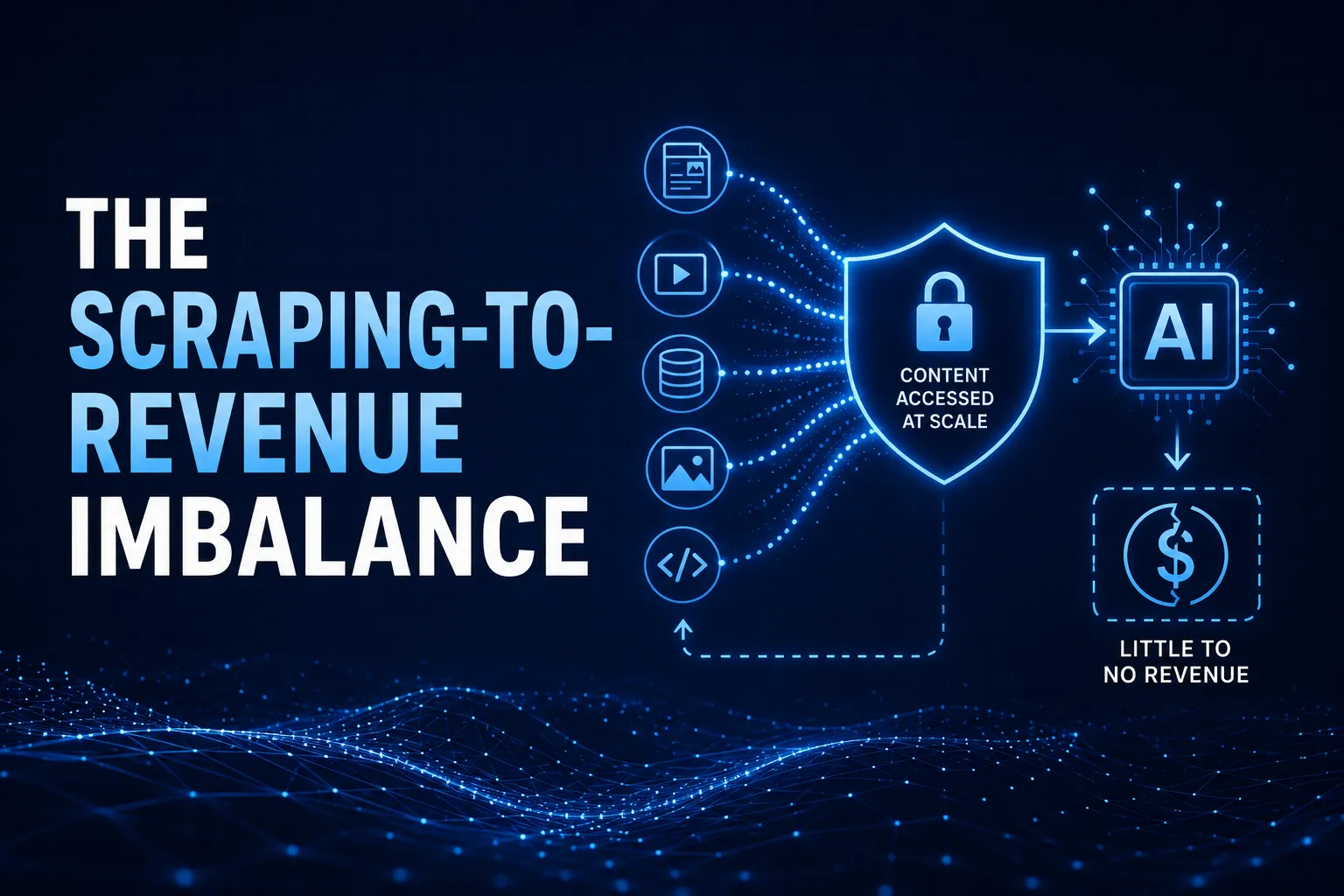
A handful of major publishers have now signed content licensing deals with large AI companies. Those agreements are real, and they matter. But they cover a tiny fraction of the content that AI systems actually consume. The vast majority of the web is produced by independent publishers, niche outlets, specialist data providers, forums, documentation sites, and individual creators. That long tail is consumed at scale by AI systems and compensated almost not at all.
This is the long-tail licensing problem. It exists because bilateral negotiation does not scale. A deal between two large organizations involves lawyers, account teams, custom terms, and months of discussion. That cost structure works when the content is valuable enough and the counterparty large enough to justify it. It collapses the moment you try to apply it to a million small sites, because the transaction cost of each deal exceeds the value of any single agreement.
The result is a market that compensates the head and ignores the tail. The content in the tail still gets used. It trains models, feeds retrieval systems, and answers user queries. It just does so without a path to payment, because the mechanism that works for large publishers was never going to reach the rest of the web.
What the long-tail licensing problem actually is
The long-tail licensing problem is the gap between how AI systems consume content and how content licensing currently gets done.
AI systems consume broadly. A retrieval system answering a specialist question may pull from a niche blog, a technical forum, a regional news site, and a small reference database in a single workflow. None of those sources is large. Collectively, they represent most of the useful, specific, high-quality content on the web. The long tail is not low-value content. It is often the opposite, because specialized and niche material is exactly what general-purpose models lack and retrieval systems need.
Licensing, by contrast, currently happens narrowly. The deals that exist are bilateral, negotiated one at a time between an AI company and a publisher large enough to command attention. News Corp's agreement with OpenAI was reported at more than $250 million over five years, and the disclosed agreements consistently involve brand-name archives with the leverage to command a meeting. AI content licensing for publishers has so far been an enterprise activity, available to organizations with the legal resources, the archive size, and the standing to get attention.
That mismatch is the problem. Consumption is distributed across the entire web. Compensation is concentrated at the top. The tail is where the gap is widest, because that is where content is used without any realistic path to a licensing conversation.
Why bilateral deals cannot reach the tail
The bilateral licensing model has a fixed cost per agreement that does not shrink as the deals get smaller.
Negotiating a content license involves identifying the counterparty, agreeing on scope, defining permitted uses, setting a price, drafting terms, and signing. Each of those steps takes human time on both sides. This is the transaction cost that economists have long identified as the reason some exchanges happen and others never do. When the cost of arranging a deal is higher than the value of the deal itself, the exchange does not occur, even when both parties would benefit in principle.
For an agreement worth a significant annual sum, that overhead is worth absorbing. For one worth a few hundred dollars a year, the overhead exceeds the value of the deal entirely. The evidence is visible in what gets announced. No AI content licensing deal under roughly $10 million has been publicly disclosed, which means a deal sized for a small publisher would fall below the threshold at which deals are even worth structuring. No AI company is going to staff a team to negotiate individually with a million small publishers, and no small publisher can afford to negotiate individually with every AI company.
The asymmetry compounds because the parties are mismatched in size. A large publisher negotiating with a large AI company is a meeting of comparable institutions. An independent creator has no comparable standing, no legal department, and no leverage. Even publishers large enough to want a deal report that their outreach to AI companies often goes unanswered. For the long tail, there is no counterparty willing to spend the negotiation cost on a deal that small. Independent and mid-sized publishers are structurally excluded from the licensing market that the largest media companies are starting to build.
Why the tail matters more than its size suggests
It is tempting to assume the long tail is economically marginal because each piece of it is small. That assumption is wrong, for two reasons.
The first is aggregate volume. The long tail is most of the web. Any individual niche site contributes little, but the sum of all niche sites is the majority of the content that AI systems draw on. A model or retrieval system that lost access to the entire long tail would lose access to most of the specific, current, specialized knowledge that makes it useful. The head of the distribution provides brand-name reporting. The tail provides depth, range, and coverage of the topics no single large publisher addresses.
The second is content quality in specialized domains. The most valuable content for many AI use cases is not the most popular. It is the most precise. A detailed technical write-up on a narrow engineering problem, a specialist medical resource, a regional dataset, or an expert forum thread can be worth more to an AI system answering a specific query than a general news article, because it contains information that exists nowhere else. The pattern is already visible in the platform data deals that have been struck, where developer Q&A from Stack Overflow and community discussion from Reddit became among the most cited sources across AI assistants. The economic value of that kind of content is high. For the millions of smaller sources that resemble it but lack the scale to negotiate, the market value returned is currently zero.
This is why the long-tail licensing problem is not a fairness footnote. It is a market design failure that strands the majority of the web's content value, including some of its most useful material.
How this connects to the broader monetization failure
The long-tail licensing problem is one expression of a wider set of structural failures that AI has introduced for content businesses.
The scraping-to-revenue imbalance describes the gap between how much content AI systems access and how little revenue that access returns. The long-tail problem explains why that gap is hardest to close at the bottom of the distribution, where no licensing mechanism currently reaches. The monetization gap in generative AI describes the distance between AI usage and AI revenue across the market. The long tail is where that distance is most extreme, because the content is consumed at full scale while the compensation infrastructure is entirely absent.
These problems share a root cause. The mechanisms built for human-scale, deal-by-deal commerce do not operate at machine scale or machine speed. Bilateral licensing is the human-scale version of content compensation. It works for the few relationships large enough to justify the overhead, and it fails for the millions that are not. Closing the gap requires moving licensing from a negotiated act to a programmatic one, because only software can absorb the transaction cost of compensating the tail.
What a scalable solution requires
Solving the long-tail licensing problem means removing the per-deal negotiation cost that makes small licenses uneconomic. That requires three things to operate without manual intervention.
The first is standardized, machine-readable terms. A small publisher cannot negotiate a custom contract with every AI company, but they can declare their licensing terms once, in a format that any automated system can read and act on. Machine-readable licensing replaces the negotiation step with a declaration step. Instead of a meeting, there is a published policy that software can discover and comply with. Standards like RSL exist precisely to let publishers of any size express how their content may be accessed, used, and priced, so that the terms travel with the content rather than living in a bespoke contract.
The second is enforcement at the access layer. Declared terms only matter if they can be applied when a request arrives. Programmatic licensing connects the declaration to the access path, so that an AI system encountering the content can read the terms, determine whether its use is permitted, and proceed under a licensed path or be denied. Without enforcement, a declaration is just a polite request. With it, the terms become operational for a site of any size.
The third is aggregated settlement. A single small license generates a tiny amount of revenue, and processing each one individually would cost more than it returns. The economics only work if millions of small events are aggregated and settled together. This is the same logic that made micropayments viable for human readers, where a running tab accumulates many small charges and settles them once rather than processing each one separately. Applied to the long tail, aggregation is what turns a million sub-dollar licensing events into a settleable revenue stream. The per-transaction cost that kills individual small deals disappears when the transactions are pooled.
Together, these three capabilities replace the negotiated deal with an automated one. Terms are declared once, enforced at runtime, and settled in aggregate. That is the only structure that can extend the licensing market to the parts of the web that bilateral negotiation will never reach.
Why this is the mechanism we are building toward
We care about the long-tail licensing problem because the parts of the web that bilateral deals exclude are most of the web, and because the infrastructure required to include them is the same infrastructure we have been describing throughout this work.
Our starting point was the gap between ads and subscriptions for human readers, where most visitors never convert and most willingness to pay goes uncaptured. The long-tail licensing problem is the machine-era version of the same failure. Most content owners are too small to negotiate, most usage goes uncompensated, and the value is real but the mechanism is missing. Supertab Connect is built to close that gap by letting any content owner declare machine-readable terms, enforce them at the edge, and collect aggregated settlement for machine access, without building custom infrastructure or negotiating a single bilateral deal. The same settlement engine that aggregates human micropayments aggregates machine licensing, which is what makes the long tail economically reachable.
That matters because the alternative is a two-tier web. In one tier, a few large publishers license their content and capture AI revenue. In the other, everyone else absorbs the cost of machine consumption with no path to compensation. Some governments are already exploring statutory licensing regimes precisely because the bilateral market is leaving most publishers behind. A market that only works for the head is not a functioning market. It is a temporary arrangement that leaves most of the web's value unpriced.
Where the long-tail problem leaves the market
The long-tail licensing problem is the reason most content owners are currently excluded from the AI licensing economy. AI systems consume content from across the entire web, but the licensing deals that return revenue exist only for the largest publishers, because bilateral negotiation cannot scale to the millions of smaller sites that produce most of the content.
Closing the gap requires replacing negotiation with declaration, manual enforcement with programmatic control, and individual settlement with aggregation. None of those capabilities requires new invention. They require assembling machine-readable licensing, access-layer enforcement, and pooled settlement into a system that operates without a human in the loop for each transaction. That is what makes the long tail reachable, because the only way to compensate a million small content owners is to make compensating each one cost almost nothing. Until that infrastructure is standard, most of the web's content will keep doing economic work for AI systems while sitting outside any market that pays for it.


