
What AI Means for Independent and Mid-Sized Publishers: Survival, Scale, and Structural Asymmetry in the Generative Era
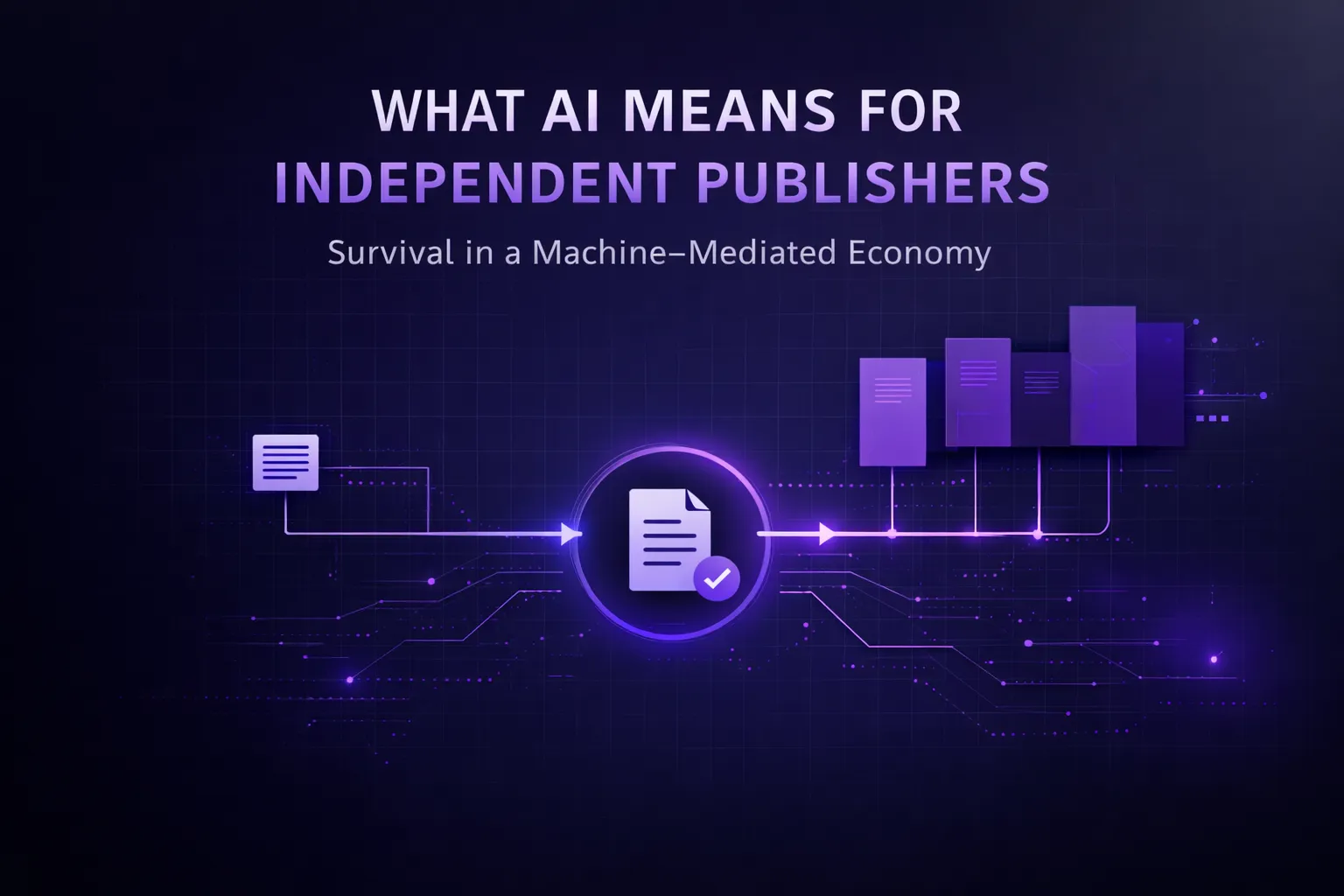
Independent publishers have always operated closer to the margin. Revenue often depends on search visibility, affiliate flows, programmatic advertising, and tightly managed subscription bases. There is less insulation, fewer diversified revenue layers, and limited negotiating leverage. Generative AI accelerates the structural weaknesses already embedded in this model.
AI systems such as Google’s Search Generative Experience and Microsoft’s AI-powered Bing increasingly deliver synthesized answers inside platform interfaces. When answers appear without requiring a click, smaller publishers lose the interaction that monetizes their work. For organizations dependent on referral traffic, that shift is immediate and measurable.
The economic impact extends beyond visibility. Independent publishers face structural asymmetry in negotiating power, revenue diversification, and access to licensing agreements. Generative AI amplifies these differences, concentrating leverage among larger media organizations while smaller publishers absorb traffic loss without equivalent compensatory mechanisms.
The Structural Imbalance Facing Smaller Publishers
Enterprise publishers possess leverage. They control extensive archives, have legal resources, and can negotiate direct AI licensing agreements. Independent publishers typically cannot. Their content may be valuable collectively, but individually it lacks the bargaining power required to secure bespoke compensation frameworks.
This creates a two-tier system. As reported by outlets such as Reuters and The Guardian, large media organizations have begun signing direct licensing deals with AI companies, while smaller publishers remain largely outside these arrangements.
When AI systems extract informational value from smaller outlets without structured compensation, the imbalance widens. The legal cost of challenging usage often exceeds the realistic recovery potential, and blocking AI access may preserve intellectual property while simultaneously reducing discoverability. Over time, these conditions shift negotiating leverage toward the largest media organizations and reinforce consolidation pressures within the publishing market.
Why Traffic Economics Erode Faster at Smaller Scale
Independent publishers depend heavily on traffic volume. Advertising revenue correlates directly with impressions. Affiliate revenue depends on click-through behavior. Newsletter growth relies on sustained referral flow.
Generative AI compresses the user journey. A single AI-generated response can replace multiple pageviews. Google’s documentation on generative search demonstrates this structural compression of interaction.
When impressions decline, revenue declines proportionally. There is no large subscription base to absorb volatility. There is no diversified licensing portfolio to offset losses.
Traffic was once a scalable growth engine. Under AI mediation, it becomes a declining asset.
Subscription Models Do Not Fully Offset the Risk
Some independent publishers operate membership programs or paid newsletters. However, subscription growth depends on discoverability and differentiated value. As AI systems summarize informational content, the urgency to subscribe weakens.
At the same time, consumers face increasing subscription fatigue across digital services. Research on churn and subscription saturation in adjacent markets has been documented by Deloitte. Smaller publishers compete for limited discretionary spending alongside streaming platforms, SaaS tools, and enterprise productivity services.
Subscriptions can stabilize revenue. They cannot independently replace traffic losses at scale without additional structural support.
The Risk of Exclusion from the AI Licensing Economy
The emerging AI licensing landscape risks reinforcing hierarchy. When compensation frameworks are negotiated primarily through large bilateral agreements, independent publishers remain structurally excluded from meaningful participation.
The core issue concerns infrastructure design. Licensing systems determine who can participate, under what conditions, and at what cost.
Machine-readable licensing standards and collective participation models allow smaller publishers to aggregate leverage and reduce transaction friction. Standards such as Really Simple Licensing illustrate how rights can be expressed in structured formats interpretable by automated systems. Collective coordination initiatives aim to create consistent signaling mechanisms and lower negotiation barriers across the ecosystem.
For independent publishers, collective infrastructure functions as a mechanism for economic inclusion. Shared frameworks reduce the likelihood of isolation and limit the risk that AI usage occurs without structured compensation.
Collective Infrastructure as Economic Equalizer
Independent publishers cannot negotiate individually with every AI developer. They require interoperable systems that:
- Signal usage permissions clearly.
- Provide visibility into AI access patterns.
- Enable participation in shared licensing frameworks.
- Support programmatic settlement for usage-based compensation.
Collective models reduce transaction costs and align incentives across scale. They allow independent publishers to participate in a licensing economy without incurring prohibitive legal or technical overhead.
AI monetization becomes viable only when rights expression connects to automated settlement at ecosystem scale.
The Shift from Exposure to Participation
The central transformation is economic. For independent publishers, the pageview has long functioned as the primary unit of value, anchoring advertising revenue, affiliate performance, and audience growth. Under AI-mediated distribution, pageviews become less predictable and less directly tied to content consumption, as AI systems increasingly train on, retrieve, and incorporate publisher material without requiring a click-through interaction.
In this environment, the relevant unit of value shifts toward usage. AI systems interact with publisher content through training datasets, retrieval layers, and inference-level integration that may not generate traditional traffic signals. When these interactions remain unmeasured and uncompensated, independent publishers effectively supply value to the AI ecosystem without participating in its economic returns.
Sustained participation in this environment depends on infrastructure that can measure usage, signal permissions, and enable coordinated settlement mechanisms across the ecosystem. Independent publishing has historically benefited from open distribution models, but machine-mediated access introduces new dynamics in which openness without structured licensing frameworks increases the risk of uncompensated extraction.
A Narrow Window for Structural Inclusion
AI monetization architecture is still forming. Regulatory bodies, including the European Commission through its evolving AI policy framework, are evaluating governance, transparency, and copyright standards. At the same time, industry norms around licensing, attribution, and programmatic settlement remain unsettled, leaving room for structural influence in how participation is defined.
Independent and mid-sized publishers have limited leverage individually, yet early participation in interoperable licensing frameworks increases the probability of inclusion in durable economic models. Delayed adaptation increases the likelihood that licensing ecosystems consolidate around enterprise-scale agreements, concentrating negotiating power and limiting access for smaller actors.
Generative AI reshapes the economic foundations of independent publishing by altering how value is captured and distributed. In a machine-mediated environment, publishers that integrate structured licensing infrastructure and coordinated participation mechanisms are better positioned to sustain economic viability as usage-based models mature across the ecosystem.


