
The Enforcement Layer: Controlling Access
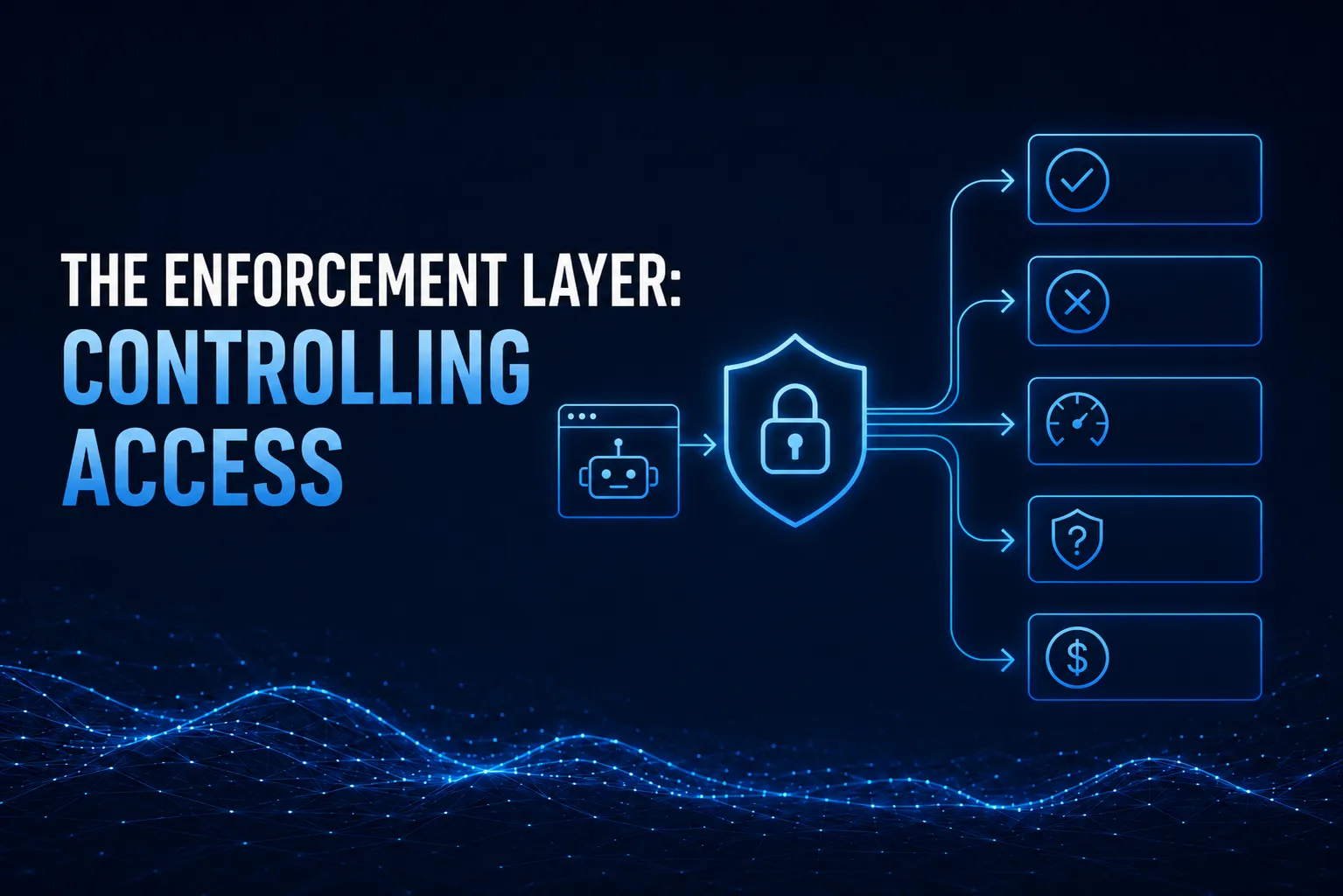
A declared policy and an identified requester are inputs. On their own, they change nothing. Something has to act on them at the moment a request arrives, granting access to a permitted use, refusing a prohibited one, and requiring payment where the policy attaches a price. That action is the enforcement layer.
Enforcement is the point in the stack where intent becomes effect. The policy layer says what is allowed. The detection layer says who is asking. The enforcement layer does something about it. Without this layer, a policy is advisory, a rule that a well-behaved requester might honor and a poorly-behaved one can simply ignore. Enforcement is what removes the option to ignore, because it applies the decision at the access path rather than trusting the requester to apply it themselves.
This matters because the current default for machine access is voluntary compliance, and voluntary compliance is failing. Rules that depend on the requester's goodwill do not hold when a growing share of requesters have an incentive to disregard them. Enforcement replaces goodwill with a decision the requester cannot route around.
What the enforcement layer does
The enforcement layer is the part of the stack that takes a policy decision and applies it to a live request.
Its job is to convert a rule into an outcome. Given an identified requester and the policy that governs the requested content, the enforcement layer determines what actually happens: the content is served, the request is refused, access is throttled, the requester is challenged to prove itself, or the request is redirected into a licensed path where payment can occur. Every one of those is an enforcement action, and the layer's role is to select and execute the right one.
The defining property is that enforcement happens at the point of access, not after it. A terms-of-service page describes a rule but enforces nothing, because it sits to one side of the request rather than in its path. Real enforcement is inline. It stands between the request and the content, so that the decision is applied before the content is served rather than litigated afterward. This is the difference between a policy that governs access and a policy that merely comments on it.
Why enforcement has to be more than blocking
The instinctive form of enforcement is blocking: decide a requester is unwanted and refuse it. Blocking is a legitimate enforcement action, but a system that can only block is a system that cannot support a market, because the useful outcomes live between full access and full denial.
Consider what a content owner actually wants. They may want to allow a search crawler that drives discovery, deny a training crawler, grant a licensed agent paid access, and throttle an unidentified client to a safe rate. Those are four different enforcement actions for four different requesters against the same content. A layer that can only allow or deny cannot express any of the conditional outcomes in between. It collapses a market that needs gradients into a binary that serves no one, which is the same trap that leaves so many owners choosing between giving content away and locking it up entirely.
The market has recognized this. Cloudflare's approach to AI crawlers gives content owners three actions rather than two: allow the crawler free access, charge it a configured price, or block it outright. The middle option is the important one, because it is the enforcement action that turns access into a transaction rather than a refusal. An enforcement layer built only to block can protect content. An enforcement layer built to allow, charge, and block can monetize it.
How enforcement works at the access path
Enforcement has to live where requests are handled, which in practice means at the edge, the layer that sits in front of content before it is served.
The mechanics are more mature than they are often assumed to be, because they build on existing web infrastructure rather than requiring anything new. A request arrives. The system identifies the requester, checks the policy that applies, and returns a response that reflects the decision. If access is permitted, the content is served with a standard success response. If payment is required, the system can return an HTTP 402 Payment Required response carrying the price, a status code reserved for exactly this purpose since the early web and now being put to use. The requester can then retry with payment intent, and if the terms are met the content is served and the event is logged for settlement.
This is not a fringe experiment. On an average day, Cloudflare customers already send over a billion 402 responses, which shows how much demand there is to move machine access from blocking toward communicated terms. The 402 response is doing the work of enforcement: it applies the policy's pricing condition at the moment of the request, in a form the requesting software can read and act on. Enforcement expressed this way is not a barrier so much as a turnstile. It does not only keep requesters out. It tells them the price of coming in.
Enforcement also has to respect precedence, because a stack has multiple controls that can act on the same request. A hard block has to override a charge, for instance, so that a requester an owner has decided to exclude cannot buy its way past the exclusion. Cloudflare's implementation reflects this: a block configured in its security tools overrides the charge action, so a blocked crawler is denied regardless of willingness to pay. A coherent enforcement layer resolves these conflicts predictably, because ambiguous enforcement is barely enforcement at all.
Why enforcement depends on the layers beneath it
Enforcement cannot act correctly on inputs it does not have. Its accuracy is bounded by the quality of the policy it applies and the identification it acts on.
The dependency on the policy layer is direct. Enforcement applies a rule, and the rule has to be declared before it can be applied. If the policy does not distinguish between indexing and training, enforcement cannot either, because it has nothing to distinguish on. A precise policy makes precise enforcement possible. A vague one forces enforcement back toward the blunt binary.
The dependency on the detection layer is just as direct. Enforcement acts against a requester, so it has to know which requester it is acting against. If detection cannot separate a licensed agent from an anonymous scraper, enforcement cannot grant one paid access while denying the other, because to the enforcement layer they look identical. This is why verifiable identity matters so much for enforcement. The more reliably a requester can be identified, the more confidently the enforcement layer can extend a paid path rather than defaulting to a block. Enforcement is only as discriminating as the detection feeding it.
This chain of dependency is why these layers are described as a stack rather than a set of independent tools. Enforcement is where the earlier layers pay off, and it is also where their weaknesses surface. A strong enforcement layer built on weak declaration or weak detection still produces poor outcomes, because it is faithfully applying bad inputs.
Why enforcement is the layer that changes behavior
The reason enforcement matters more than any single layer is that it is the one requesters actually feel. A policy can be declared and a requester detected without anything changing for that requester. Enforcement is the moment the system's decision reaches the requester and shapes what they can do.
This is what makes enforcement the corrective for the failures earlier in this series. The scraping-to-revenue imbalance persists partly because access is not enforced in a way that attaches compensation to it. The gap between how much AI systems crawl and how little they return is visible in the numbers: Cloudflare has reported that one major AI company's crawler accessed tens of thousands of pages for every single visit it referred back, a ratio that makes the absence of enforcement concrete. Unenforced access is access without consequence, and access without consequence is what allows consumption to outrun compensation. Enforcement is what reintroduces the consequence, because it applies a cost or a limit at the point where value would otherwise leave unpriced.
Enforcement is also what makes programmatic licensing real rather than notional. A license that cannot be enforced is a request for good behavior. A license that is enforced at the access path is a rule with teeth. The difference between the two is the enforcement layer, which is why licensing without enforcement keeps collapsing back into the voluntary compliance that failed in the first place.
Turning declared terms into real consequences
The enforcement layer is where a declared policy becomes an actual outcome for a requester. It applies the decision at the moment of access, allowing permitted use, refusing prohibited use, throttling risky use, and routing billable use into a path where payment can occur.
It has to be more than a blunt block, because a market needs the conditional outcomes that sit between open access and full denial. It has to operate inline at the access path, because a rule enforced anywhere else is a rule a requester can ignore. And it depends entirely on the declaration and detection beneath it, because enforcement can only be as precise as the policy it applies and the identity it acts on. This is the layer that turns the rest of the stack from description into control, because until a rule is enforced, it is only a preference, and AI systems consuming content at scale have shown they will not treat a preference as a limit. Supertab Connect is built to enforce declared terms at the edge for exactly this reason, so that the decision an owner has made is the decision a requester actually meets.


