
Why AI Needs Programmatic Commerce Infrastructure
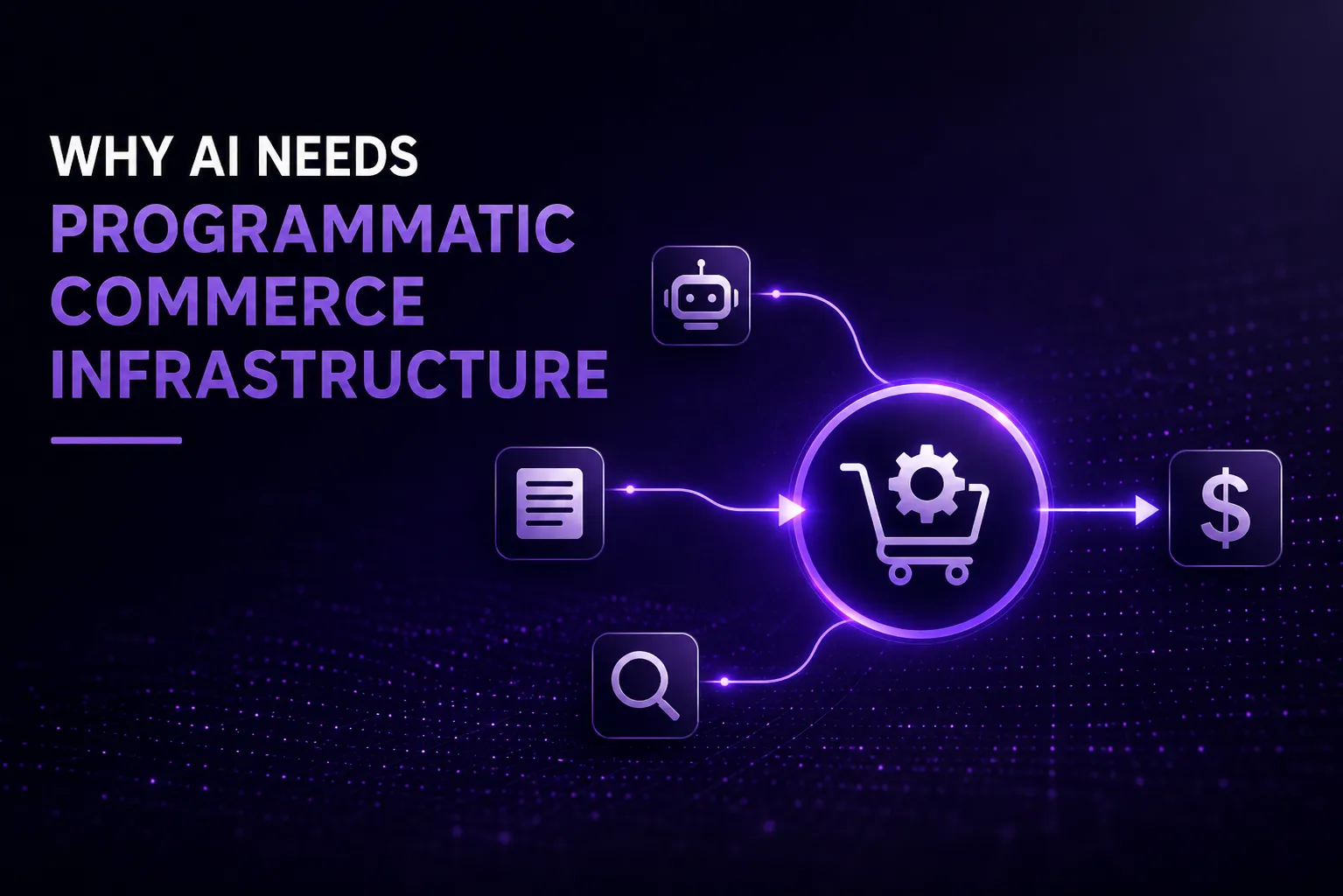
The commercial infrastructure underneath the internet was built for humans. A person visits a website, decides to buy something, enters payment details, and completes a transaction. Even the most automated parts of digital commerce, programmatic advertising, API billing, SaaS subscriptions, were designed with human decision-making at the origin of the transaction. A person signed up, agreed to terms, and set a payment method in motion. The ongoing activity was automated, but the initiating act was human.
AI systems break that assumption. An autonomous agent executing a research task does not pause to sign up for a service, agree to terms, or enter payment details. A retrieval-augmented system pulling from licensed content sources at inference time does not negotiate access before each query. A foundation model provider managing millions of daily inference requests cannot maintain a manual billing relationship with every content source its system touches. The activity is machine-initiated, continuous, and operating at a volume and speed that human-centric commerce infrastructure cannot match.
This is not a marginal edge case. It is the structural condition of the AI economy as it scales. The gap between how AI systems consume digital value and how that value is currently measured, priced, and settled is widening with every increase in AI adoption. Programmatic commerce infrastructure is the layer that closes that gap, and its absence is one of the central friction points limiting how the AI economy develops.
What programmatic commerce infrastructure actually means
Programmatic commerce is not a single product or standard. It is a set of capabilities that together allow economic transactions to be initiated, executed, and settled by software systems without requiring human action at each step.
Those capabilities include machine-readable rights expression, so that AI systems can determine what they are permitted to access and under what conditions before they attempt to use it. They include access control at the infrastructure layer, so that permissions are enforced technically rather than relying on good faith compliance. They include usage metering, so that every access event is measured accurately and attributed to the correct source and consumer. They include automated billing, so that payment obligations are triggered by verified usage rather than estimated in advance. And they include settlement infrastructure, so that funds move between parties at the speed and granularity that machine-driven commerce requires.
Each of these capabilities exists in partial form in different parts of the current digital infrastructure. What does not yet exist at scale is a coherent, interoperable layer that connects all of them across the AI ecosystem. That fragmentation is why AI companies manage content costs through a patchwork of annual agreements, manual reconciliation processes, and informal access arrangements that do not reflect the actual economics of how their systems operate.
The volume problem makes manual approaches unworkable
The most immediate reason AI needs programmatic commerce infrastructure is volume. A large AI product may process millions of queries per day. Each query may involve multiple retrieval events, tool calls, or data accesses. Each of those interactions potentially involves a content or service provider whose material is being used to generate a response.
Manual licensing cannot operate at this frequency. A bilateral agreement negotiated once per year cannot accurately price usage that varies by orders of magnitude across days, query types, and user segments. An invoice sent monthly cannot provide the granularity needed to understand which content sources are generating the most value or where retrieval costs are highest. Human-reviewed terms of service cannot be checked at the speed of an inference request.
The scale of AI agent activity makes this problem more acute because agents generate consumption patterns that are fundamentally discontinuous. A single agent task may generate a burst of hundreds of retrieval events over a few minutes and then go dormant for hours. Billing infrastructure that cannot track and price that kind of irregular, high-frequency consumption will either overbill, underbill, or fail to bill at all, none of which produces a sustainable commercial relationship between AI systems and the services they depend on.
The attribution problem undermines pricing without infrastructure
Programmatic commerce infrastructure is also necessary because without it, attribution breaks down. When an AI system generates a response, the value of that response is a function of multiple inputs: the foundation model's capabilities, the retrieval sources consulted, the tools called, and the data accessed. Each of those inputs carries a cost, and the commercial relationships underlying them require accurate attribution to function correctly.
Without metering and attribution infrastructure, AI companies cannot answer basic questions about their own cost structure at the query level. Which content sources are contributing most to answer quality? Which retrieval events are generating costs that exceed the value they add? Which licensing agreements are being underused and which are being exhausted? These are not abstract questions. They are the inputs to pricing decisions, content partnership negotiations, and product design choices about which retrieval sources to prioritise.
The same attribution gap creates problems for content providers. A publisher or data owner that has licensed access to an AI system needs visibility into how that access is being used to price future agreements rationally, to verify compliance with existing terms, and to build the usage data that supports renewal negotiations. Without that visibility, licensing agreements are priced on guesswork and enforced on trust, neither of which scales as the commercial stakes increase.
This is one reason machine-readable licensing and usage monitoring are foundational requirements rather than optional enhancements. Rights expression tells the system what is permitted. Monitoring records what actually happens. Both are prerequisites for attribution, and attribution is a prerequisite for any pricing model that reflects the real economics of AI content consumption.
The settlement gap creates compounding commercial risk
Even where usage is measured and attribution is clear, settlement introduces its own friction. Current payment infrastructure operates on timescales and at granularities that do not match AI consumption patterns. Monthly invoicing cycles cannot reflect usage that peaks and troughs within hours. Payment rails designed for human-initiated transactions introduce friction that compounds at the frequency of machine-driven commerce.
The settlement gap creates compounding commercial risk for both sides of the transaction. For content providers, delayed or inaccurate settlement means that revenue from AI usage is difficult to forecast, difficult to audit, and difficult to use as the basis for strategic decisions about licensing terms or access policies. For AI companies, accumulated but unsettled usage obligations represent a liability that grows invisibly until it becomes a reconciliation problem or a legal one.
Visa's work on agentic payment frameworks and Mastercard's research into agent-compatible commerce both reflect how seriously payment infrastructure providers are engaging with the settlement problem at the machine commerce layer. The direction is toward programmable, policy-governed settlement that can operate at the speed and granularity of AI activity rather than requiring human action to initiate or complete each transaction.
Standards are the foundation of interoperability
Programmatic commerce infrastructure cannot function if every AI company, content provider, and service operator implements it differently. Interoperability requires shared standards that allow rights to be expressed, read, and acted on consistently across systems that have no prior commercial relationship.
The Really Simple Licensing standard provides that foundation for content rights, defining a machine-readable format that AI systems can interpret without requiring a bespoke integration for each content source. The extension of the RSL framework into human identity and creative rights through RSL Media reflects how the same standards architecture is expanding to cover a broader range of rights holders as the scope of AI content consumption widens beyond web publishing.
Standards adoption is accelerating because the alternative, a fragmented landscape of incompatible rights declarations and proprietary settlement systems, imposes costs on every participant. AI companies that need to manage content access across thousands of sources cannot do so efficiently without a common protocol. Content providers that want to participate in the AI licensing economy without bespoke engineering for each potential customer need a standard that any compliant system can read. Regulators that want to enforce transparency and consent requirements need a technical substrate that makes compliance verifiable rather than declaratory.
The EU AI Act and the broader direction of AI governance frameworks in multiple jurisdictions are pushing toward exactly this kind of structured, auditable approach to AI content access. Standards that enable programmatic commerce also enable programmatic compliance, which reduces the regulatory burden on both AI companies and rights holders compared to systems that rely on human review of each access relationship.
Infrastructure as competitive advantage
For AI companies, programmatic commerce infrastructure is not only a cost management tool. It is increasingly a source of competitive advantage because it enables commercial relationships that less-equipped competitors cannot maintain.
An AI company that can offer content providers clear usage data, automated settlement, and machine-readable access terms is a more attractive licensing partner than one that relies on annual agreements and manual reconciliation. That advantage compounds over time because content providers will preferentially license to systems that can track and pay for usage accurately, which improves the quality and breadth of content available to well-equipped AI products relative to those that cannot demonstrate reliable usage governance.
The same logic applies to enterprise customers. Organisations deploying AI in regulated industries, or those with significant data governance requirements, increasingly require their AI vendors to demonstrate that content access is properly licensed, tracked, and settled. The ability to provide that assurance is moving from a differentiator to a threshold requirement in enterprise procurement.
Supertab Connect is built as the managed infrastructure layer that makes this possible for content providers without requiring them to build the underlying systems themselves. By handling rights expression, edge enforcement, usage monitoring, and settlement in a single managed layer built on the RSL standard, it enables the kind of programmatic commerce relationship that the AI economy requires, on both sides of the transaction.
The network effect of infrastructure adoption
Programmatic commerce infrastructure becomes more valuable as more participants adopt it, because each additional rights holder that publishes machine-readable terms increases the universe of content that AI systems can access under clear, enforceable, and automatically settleable conditions.
That network dynamic creates an adoption incentive that goes beyond individual commercial benefit. Early participation in standards-based programmatic commerce infrastructure positions both content providers and AI companies within an ecosystem that will increasingly define the norms of AI content access. Late participation means operating within rules set by others, often rules that reflect the priorities of the largest and earliest participants rather than the broader market.
The strategic options available to publishers in the AI era have consistently pointed toward infrastructure participation as a more durable response than either open access or blanket blocking. The same logic applies across the broader AI economy. Programmatic commerce infrastructure is not a defensive measure. It is the architecture of a market that can function at AI scale, and the participants that help build it will operate within it on better terms than those that wait for it to arrive fully formed.
The Participants Who Build This Will Set the Terms for Everyone Else
The AI economy will not reach its commercial potential without programmatic commerce infrastructure. The volume, speed, and complexity of machine-driven consumption cannot be governed by manual agreements, human-initiated payments, or informal access norms. The gap between AI activity and economic accountability will widen until the infrastructure layer that connects them is built and adopted at scale.
That infrastructure is being assembled now, through standards bodies, payment networks, content licensing platforms, and AI companies that recognise the commercial and regulatory imperative of bringing their consumption patterns into alignment with structured economic frameworks. The organisations that contribute to that assembly, and adopt the resulting infrastructure early, will shape the commercial architecture of the AI era in ways that benefit them disproportionately as the market matures.


