
What AI Monetization Means for AI Agents Acting Autonomously
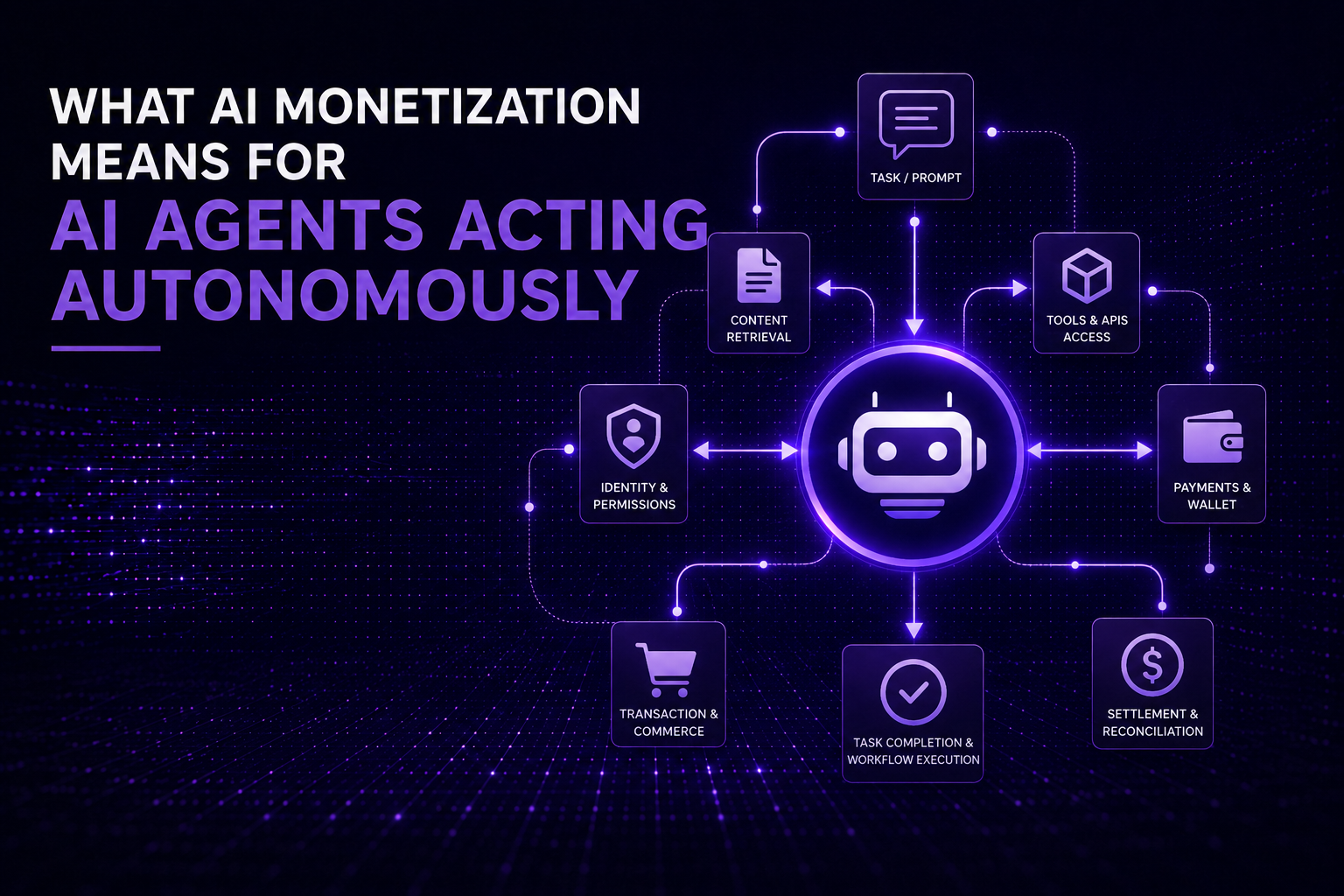
Autonomous AI agents are software systems that pursue goals across multiple steps, tools, and services without requiring a human to approve each action. They do not browse. They execute. A user instructs an agent to research a topic, compile a report, book a service, or monitor a data feed, and the agent works through the necessary sub-tasks independently, calling APIs, retrieving content, processing outputs, and completing transactions along the way.
The transition from AI tools that respond to AI agents that act is already underway. Systems like OpenAI's Operator, Google's Project Mariner, and the broader ecosystem of agent frameworks building on top of foundation model APIs represent a structural shift in how AI interacts with digital services. The difference is not incremental. A tool waits for input. An agent initiates action.
For the businesses and infrastructure providers that operate the digital services agents interact with, this shift creates an immediate practical problem. Their access models, pricing structures, and payment mechanisms were built for humans. Humans have accounts. Humans authenticate. Humans complete checkout flows, accept terms, and make decisions at each step of a transaction. Agents do none of those things in the same way, and the commercial layer has not caught up with the operational reality.
Why agent-driven activity breaks existing access models
Most digital services gate access through mechanisms that assume a human on the other side. Login flows, CAPTCHA verification, subscription agreements, and one-time payment prompts all presuppose a person reading, deciding, and acting. An autonomous agent can navigate some of these surfaces, but the friction created by human-centric access design is not incidental. It represents a fundamental mismatch between how services were built and how agents need to consume them.
Subscription models illustrate the problem clearly. A subscription bundles access to a service into a fixed recurring payment, which works because human usage tends to be regular and somewhat predictable. An autonomous agent does not consume services on a human schedule. It may need access to a data feed for thirty seconds during one task and not again for a week. It may call a content API thousands of times during an intensive research workflow and then go dormant. Forcing agent consumption into a subscription frame either overcharges for low-frequency use or undercharges for burst activity, and neither outcome is commercially rational for the service provider.
The broader implications of this mismatch for AI companies managing variable consumption costs have been explored in the context of AI startups and application builders and foundation model providers. For autonomous agents, the problem is more acute because the consumption pattern is not just variable. It is entirely decoupled from human presence.
The economics of continuous, unattended activity
Agents operate at a different cost profile than users. A single agent instance can generate more API calls, content retrievals, and service interactions in an hour than a human user generates in a month. Multiply that across enterprise deployments where hundreds or thousands of agent instances may be running in parallel, and the economic weight of agent activity becomes significant for every service provider in the stack.
That scale creates a pricing design challenge. Services that price per seat, per user, or per month were not built to absorb the consumption profile of a fleet of autonomous agents. Stripe's analysis of usage-based pricing models documents the broader shift toward consumption-aligned billing across SaaS, and the same logic applies here with greater urgency because agent activity amplifies the mismatch between flat pricing and variable consumption.
The challenge cuts in both directions. Service providers that do not adapt their pricing to agent consumption patterns will either lose margin as agents over-consume relative to price, or lose adoption as agents route around services that are too expensive or too friction-heavy to interact with programmatically. Neither outcome serves the long-term interest of building a sustainable agent economy.
Identity and authorisation at machine speed
One of the least-discussed practical challenges in autonomous agent deployment is identity. When an agent acts on behalf of a user or an organisation, the services it interacts with need a reliable way to verify who is authorising the action, what permissions apply, and whether the agent is operating within defined boundaries.
Human authentication flows were not designed for this. OAuth and similar protocols handle delegated access reasonably well in defined contexts, but autonomous agents operating across many services, some of which may not be known in advance, require a more flexible and composable identity layer. The FIDO Alliance's work on passkeys and authentication standards and emerging discussion around agent-specific identity credentials reflect early movement toward frameworks that can accommodate machine-initiated authorisation. However, the standards landscape for agent identity remains unsettled, and the gap between what agents need and what current infrastructure provides is real.
This matters commercially because authorisation is the gateway to access, and access is the gateway to the transaction. An agent that cannot reliably authenticate across services either stalls on friction or operates in ways that bypass intended access controls, neither of which produces a functional commercial relationship between the agent and the services it depends on.
Content access is a recurring cost, not a one-time permission
Autonomous agents are heavy consumers of content. Research agents retrieve and synthesise documents. Monitoring agents pull live data feeds. Analysis agents cross-reference multiple sources to build a picture that no single dataset contains. In each case, content access is not a background dependency. It is the primary input the agent is working with.
The licensing frameworks that content providers have started building in response to AI training data demand address a different problem. Training ingestion is retrospective and bounded. Agent-driven retrieval is ongoing, real-time, and tied directly to the output the agent delivers. A content provider whose material is retrieved by an autonomous agent to complete a paid enterprise task is contributing value to a commercial transaction at the moment it occurs. That relationship deserves a commercial framework that reflects the timing and specificity of that contribution.
Machine-readable licensing standards are a necessary foundation because agents cannot negotiate terms manually. They need to be able to read access conditions, confirm permissions, and proceed or halt based on what those conditions specify. Without rights expressed in a format agents can interpret, access either defaults to open, which leaves content providers uncompensated, or defaults to blocked, which degrades agent capability. Neither outcome is optimal.
Supertab Connect is built for exactly this environment. It allows content owners to publish machine-readable licensing terms, enforce access at the edge, and settle usage automatically, so that when an autonomous agent retrieves content as part of a workflow, the access is governed, recorded, and compensated without requiring a human to manage each interaction.
Payment infrastructure was not built for agents
The payment layer is where the agent economy faces some of its most concrete near-term constraints. Current payment infrastructure assumes a human completing a transaction: entering card details, confirming a purchase, approving a charge. Autonomous agents need to transact without any of those steps, which means payment must be embedded in the access layer rather than appended as a separate human-facing process.
Visa's research into agentic payment frameworks and Mastercard's work on agent-compatible commerce both reflect how payment networks are starting to engage seriously with the infrastructure requirements of machine-initiated transactions. The direction is toward programmable, policy-governed payment authorisation that agents can invoke within defined parameters, rather than requiring human approval at each transaction point.
This has practical implications for any service provider building revenue around agent consumption. If payment cannot happen automatically and at machine speed, the commercial relationship between agents and services becomes dependent on pre-authorised credit systems or post-hoc reconciliation, both of which create friction and financial risk that limit the scalability of agent-driven commerce.
Cross-stakeholder friction concentrates at the execution layer
Autonomous agents create friction across every stakeholder group they interact with, and that friction concentrates at the moment of execution because that is where access, authorisation, payment, and content licensing all have to work simultaneously.
Service providers want reliable, predictable revenue from agent consumption without having to rebuild their access models from scratch. Content owners want to capture value when agents retrieve their material as part of a paid workflow. AI companies building agent products want frictionless access to the services and content their agents depend on. Enterprise customers deploying agents want cost predictability and compliance assurance across the services their agents touch. Regulators are beginning to examine questions of accountability and transparency when agents act autonomously on behalf of humans or organisations, as reflected in early guidance emerging from the EU AI Act framework.
These interests are not irreconcilable, but they will not align without infrastructure. Informal access arrangements, manual licensing negotiations, and human-centric payment flows cannot support the agent economy at scale. The commercial layer needs to operate at the same speed and granularity as agent execution itself.
The transition from human commerce to machine commerce
The shift toward autonomous agents is not primarily a technology story. It is a commercial infrastructure story. The technology to build capable agents exists today. What does not yet exist at scale is the pricing, access, identity, and settlement infrastructure those agents need to participate in digital markets as first-class economic actors.
The services and content providers that build for agent consumption earliest will have a structural advantage because they will be discoverable and transactable by agent systems that are evaluating options programmatically rather than through human sales relationships. As explored in agentic commerce, the selection criteria that matter in a machine-driven market are different from those that matter in a human-driven one. Price transparency, reliable access, machine-readable permissions, and frictionless settlement are not nice-to-haves. They are the conditions for being selected at all.
The businesses that adapt their commercial infrastructure to agent consumption will not only serve a growing market. They will help define the norms of that market before those norms are set by the largest platforms acting in their own interest.
The Infrastructure Gap Is the Bottleneck, Not the Technology
Autonomous agents will become the primary interface through which a growing share of digital services are accessed and consumed. That shift changes everything downstream: how access is priced, how identity is verified, how content is licensed, and how payment flows between the parties in a transaction that no human directly initiates.
The commercial infrastructure for this world is being built now, in fragments, by a mix of standards bodies, payment networks, AI companies, and infrastructure providers. The organisations that engage with that process early, whether as content providers defining machine-readable terms, service providers adapting their pricing to agent consumption, or infrastructure builders creating the settlement layer underneath agent commerce, will shape the architecture that everyone else eventually operates within.


