
What AI Monetization Means for Identity Providers
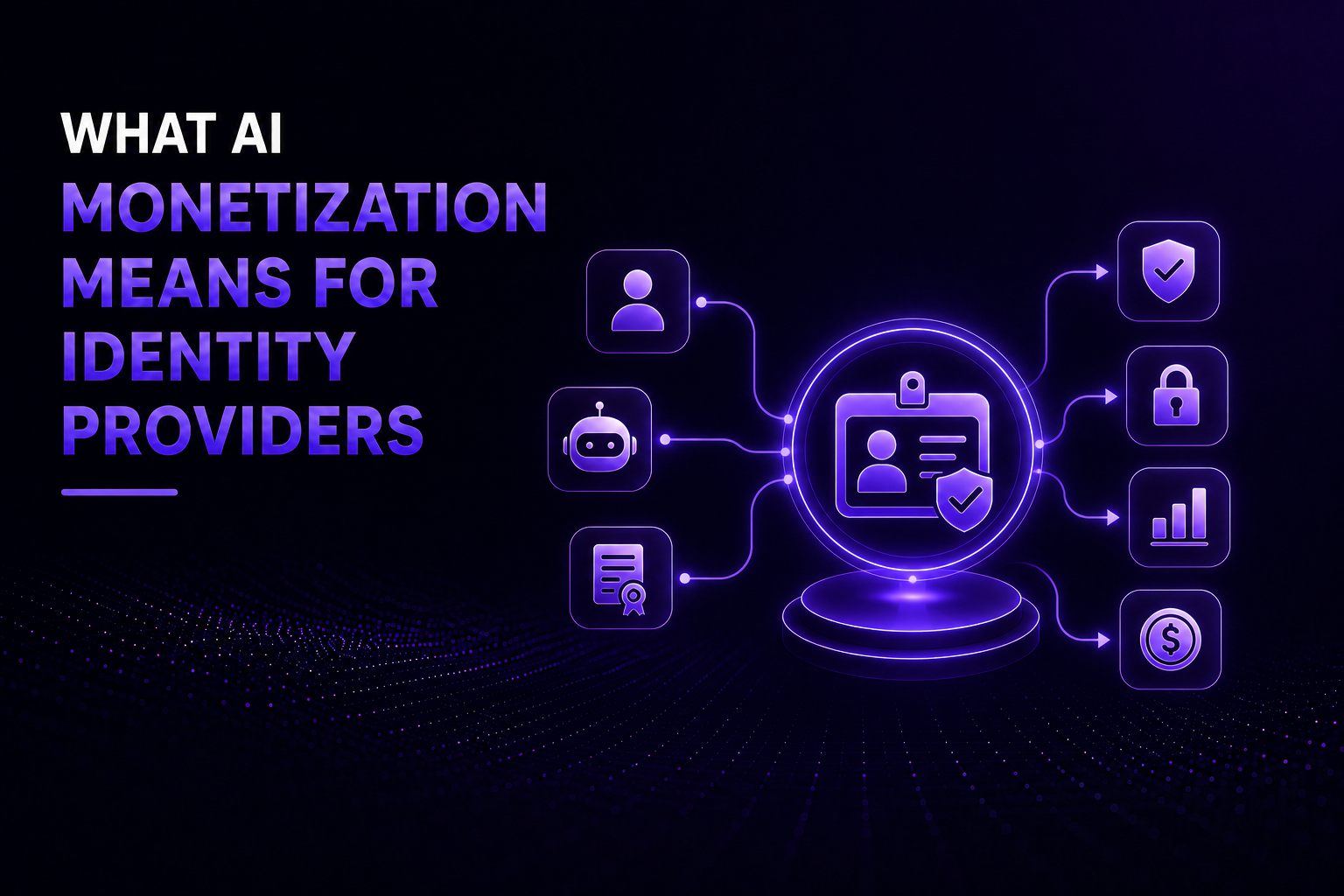
An identity provider verifies who is making a request and what they are allowed to do. It authenticates users, issues tokens, manages single sign-on, and tells the services that rely on it whether a given actor should be granted access. For most of its history this meant confirming a human: a person with a password, a second factor, and an account someone set up and stands behind.
Generative AI introduces an actor that does not fit that model. An autonomous agent is not a human, but it is also not a simple machine credential like a service account. It acts on behalf of a person or organisation, makes its own decisions across multiple systems, and does so continuously and at scale. Non-human identities already outnumber human ones by roughly 50 to 1 in the average enterprise, and agents are a fast-growing, unusually capable slice of that population. The identity layer is being asked to vouch for actors it was never designed to represent.
The revenue logic shift for identity providers follows from where they sit. Because identity is the first thing checked when access is requested, it is also the precondition for any decision about whether that access should be paid for. You cannot price access to an actor you cannot identify, and you cannot settle a transaction with a party you cannot hold accountable. As machine access becomes something to be licensed and charged for rather than simply allowed or blocked, the identity provider moves from a security function to the foundation of the commercial relationship. Whether identity providers claim that position will shape how much of the AI access economy runs through their infrastructure.
The credential model assumed a human at the end of it
The mechanisms identity providers rely on were built around human sign-in. OAuth, the protocol underpinning most delegated access, assumes persistent sessions and user consent, which is a reasonable assumption when a person is clicking to approve access to their account. It is a poor fit for fast-moving autonomous systems that act without a human pausing to consent at each step.
The existing fallback, treating an agent as a non-human identity like a service account or a static API key, fails in a different way. Those credentials are stable, long-lived, and tied to a single application, whereas agentic identities are dynamic, ephemeral, and often self-directed. Leaning on static secrets at agent scale has already produced measurable harm: one analysis found tens of millions of hardcoded secrets added to public repositories in a single year, with leak rates in AI-assisted code running roughly double the baseline. A credential model that scatters long-lived secrets across ephemeral agents is a liability, not an identity strategy.
The structural gap is that agent access is rarely one-hop. A human delegates to an agent, that agent may delegate to another, and a task may cross several services before completing. Standard delegation handles a single hop reasonably well, but determining which human principal bears responsibility for a multi-hop delegated action remains unsolved. This matters commercially, not just for security, because the party that authorised an action is the party who ultimately pays for it. An identity system that cannot trace the delegation chain cannot tell a service who to bill.
Identity is the precondition for pricing, not just for security
The reason identity sits upstream of monetization is simple. Every downstream decision about machine access depends on first knowing who is asking. A content owner deciding whether to charge a crawler, an API platform deciding what tier applies, a payment layer deciding who to settle with, all of them need a reliable answer to the identity question before they can act. When that answer is a guess based on a spoofable user-agent string, every decision built on top of it is a guess too.
This is why the identity question and the access question are inseparable. Deciding whether an agent may retrieve a piece of content, and on what terms, requires knowing what the agent is, who it acts for, and what that principal is permitted to do. That is the same connection between identity, declared rights, and enforcement that defines AI access control, and identity providers own the first and most foundational part of it. Without a trustworthy identity, machine-readable licensing terms have no one to apply to and no one to charge.
The standards landscape is converging on this understanding, treating agents as first-class identities rather than retrofitted service accounts. Google's A2A protocol lets an agent publish a signed Agent Card, a JSON document that advertises its identity, capabilities, and authentication requirements to the systems it interacts with. Efforts like the OWASP Non-Human Identity Top 10 and NIST's AI Agent Standards Initiative are formalising what agent identity needs to include. The direction is toward cryptographically verifiable identity that other systems can check without a prior relationship, which is precisely what a pricing decision at machine speed requires.
The accountability chain is where friction concentrates
Every stakeholder that meets an agent needs the same thing from identity, and none of them can get it alone. The content owner or service provider needs to know who to charge and who to hold responsible if terms are breached. The AI company operating the agent needs its agents to authenticate across services they were not pre-registered with, without a human configuring each one. The enterprise deploying agents needs assurance that an agent stays within authorised limits, because an agent that acts outside policy creates both a security incident and a financial one. Regulators need a traceable chain from any autonomous action back to the human or organisation that authorised it.
These requirements collide at the point of delegation, which is exactly where agent-to-agent commerce lives or fails. When an agent acts, the systems it touches need a verifiable answer to who authorised this, within what scope, and who is accountable for the outcome. The consequences of not having that answer are already visible: a large majority of IT leaders report agents acting outside their expected behaviour, which is another way of saying the delegation and authorisation layer is not yet doing its job. Static, one-time permission grants cannot govern actors whose behaviour is non-deterministic and whose context changes constantly.
The friction is not resolved by each service building its own agent-identity scheme, because that fragments the landscape and forces AI companies to satisfy a different identity model for every provider their agents encounter. What the ecosystem needs is verifiable identity that travels with the agent and is legible across services, so that the same credential a service uses to grant access can anchor the terms it applies and the settlement it expects. Identity providers are the natural issuers of that credential, which is what makes their role in the AI economy larger than security alone.
From verifying identity to enabling the transaction
The limitation identity providers share with every enforcement layer in the AI stack is that verification, on its own, does not produce revenue. Confirming who an agent is and what it may do is necessary for a priced transaction, but it is not sufficient. Identity establishes the party. It does not express the terms of access, measure what was consumed, or move payment for it.
Closing that gap is what turns verified identity into a commercial relationship. Once an agent is reliably identified and its authorising principal is known, the access it requests can carry machine-readable licensing terms it can read and act on, its consumption can be metered against that identity, and settlement can be attributed to the accountable party without a human negotiating it. This is the same logic that drives usage-based monetization across the rest of the stack, resting here on the identity layer that makes it enforceable. Identity is the anchor the whole chain hangs from. Metering needs an identity to attribute usage to. Pricing needs an identity to apply terms to. Settlement needs an identity to bill. Get the identity layer right and the commercial layer becomes possible. Get it wrong and nothing above it can be trusted.
Supertab Connect is built to convert that identity foundation into settled transactions on the content and service side. It identifies the consuming party at the point of access, applies the provider's machine-readable terms, meters what is used, and aggregates and settles that usage against the responsible party. For an identity provider, infrastructure of this kind is the layer that turns the identity it establishes into revenue for the services relying on it, extending verification into the full commercial relationship rather than stopping at the door.
Whoever Owns Identity Owns the Beginning of Every Transaction
Identity providers occupy the first position in every machine interaction, which is a more valuable place to stand than the security framing suggests. Every decision about whether an agent gets access, what it pays, and who is accountable begins with establishing who the agent is and who it acts for. That is not a supporting function in the AI economy. It is the foundation the rest of the economy is built on.
The providers that treat agent identity as a security problem alone will build better authentication and better anomaly detection, and they will remain one input among many. The providers that recognise identity as the precondition for commerce will build toward something more consequential: verifiable, delegation-aware identity that other systems can price against, meter against, and settle against. The technical work of authenticating agents is being standardised and will become common infrastructure. The work of connecting identity to the terms and settlement that turn access into revenue is where the durable position lies, because the party that reliably answers who is this and who authorised it holds the first link in every transaction the AI economy will ever run.


