
The Settlement Layer: Triggering Payment
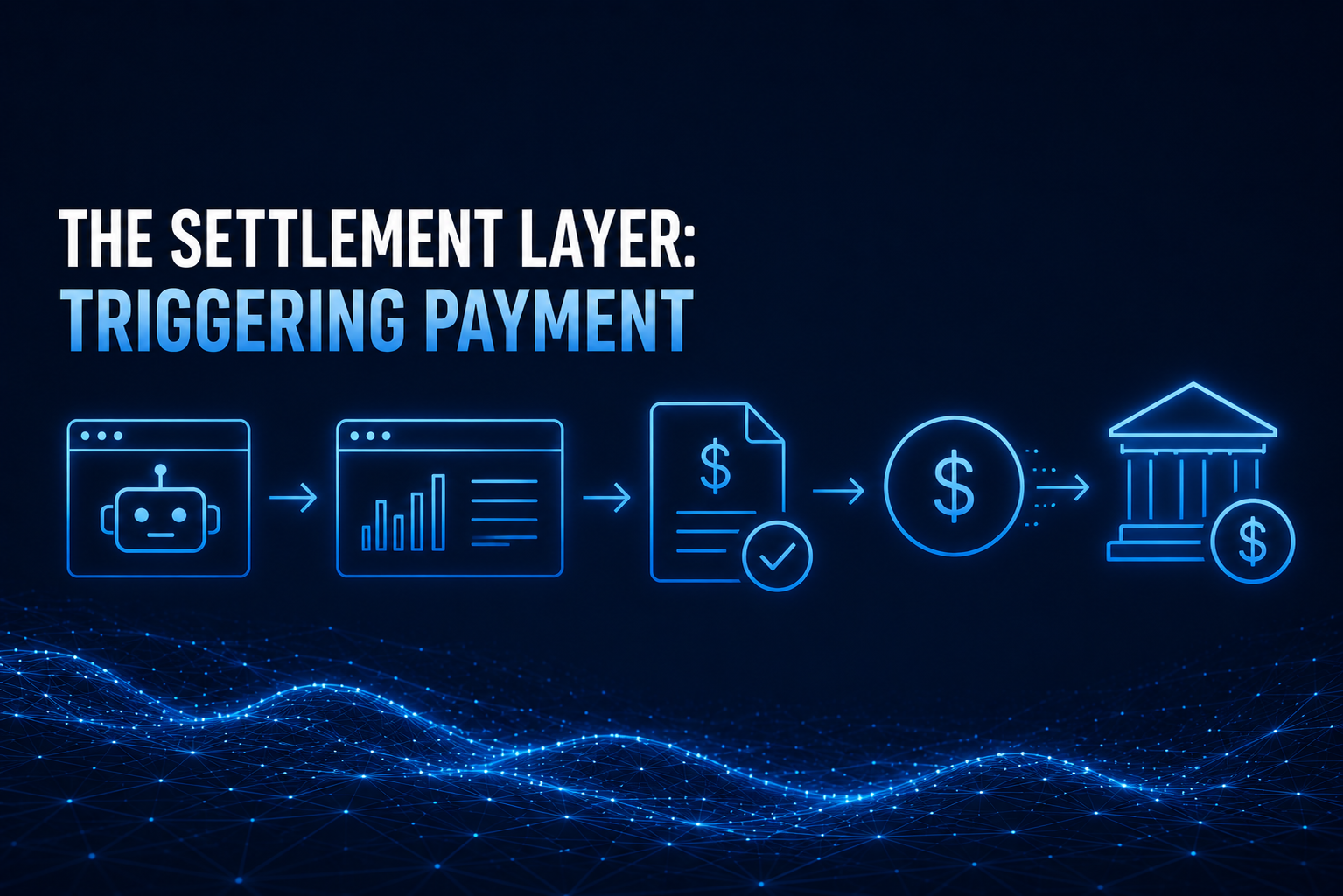
Every layer before this one prepares for a transaction without completing it. Rights are declared, requesters are identified, access is enforced, and usage is metered. At the end of that chain sits an unresolved obligation: a requester has consumed something under agreed terms, and now owes for it. The settlement layer is what discharges that obligation. It moves the money.
Settlement is the final layer in the stack because it depends on all the others and completes what they begin. The policy sets the price. Detection names the payer. Enforcement grants the access that creates the charge. Metering counts what was used. Settlement takes those inputs and executes the payment, closing the loop between value delivered and value paid. Without it, the entire apparatus produces measurement without money, which is to say it produces nothing a business can bank.
This layer matters because the AI economy generates transactions at a scale and size that traditional payment systems were never built to handle. A machine consuming content produces enormous numbers of very small charges, and settling those charges is not a solved problem. It is the problem that determines whether usage-based monetization works at all, because a price that cannot be collected is not really a price.
What the settlement layer does
The settlement layer is the part of the stack that converts a metered, priced event into a completed payment.
Its job begins where metering ends. Metering produces an accurate count of billable events. The settlement layer applies the policy's pricing to that count, determines what is owed, and executes the transfer of funds from the consuming party to the owning party. It also records that the payment happened, closing the audit trail that began at the policy layer. The output is not a number but a settled transaction, money that has actually moved and been accounted for.
Settlement is distinct from pricing, and the distinction matters. Pricing is a decision about what something should cost. Settlement is the machinery that collects that cost. A business can have a perfectly sensible price and still fail to settle it, because the mechanics of moving small amounts of money reliably, at volume, between parties who may have no prior relationship, are genuinely hard. This is why settlement is a layer in its own right rather than an afterthought to pricing. Deciding the charge and collecting the charge are different problems, and the second is where most usage-based models actually break.
Why settling small amounts is the hard part
The defining challenge of the settlement layer in the AI era is size. Machine consumption produces charges that are individually tiny and collectively enormous, and conventional payment infrastructure handles that combination badly.
The reason is transaction cost. Traditional payment rails were built for occasional, human-sized purchases, and they carry a fixed cost per transaction. When a charge is a few cents or a fraction of a cent, that fixed cost can exceed the charge itself, which makes settling each event individually uneconomic. A system that pays more to process a payment than the payment is worth cannot function. This is the same barrier that made micropayments impractical for decades, because the card networks could not handle sub-cent transactions and no one could pay for a single page view without a full checkout flow.
What has changed is that new settlement rails are being built specifically for machine-scale payments. The clearest example is the revival of HTTP 402, the long-dormant status code, as a live payment mechanism. The x402 protocol embeds stablecoin payments directly into HTTP requests, and because it settles on infrastructure where fees sit below a hundredth of a cent per transaction, it makes charges of fractions of a cent economically rational for the first time. The scale is already meaningful rather than theoretical, with the protocol having processed well over a hundred million transactions as machine-to-machine payments move from demonstration into production. The point is not the specific rail. It is that settling machine-scale charges requires infrastructure designed for the size and frequency of those charges, not infrastructure repurposed from human commerce.
Why aggregation is central to settlement
Even with cheap rails, settling every individual machine event on its own is often the wrong design. The more scalable approach is to aggregate many small events and settle them together, because aggregation attacks the transaction-cost problem from the other side.
The logic is straightforward. If a thousand sub-cent events can be pooled and settled as one transaction, the per-transaction cost is paid once rather than a thousand times. Aggregation turns a stream of charges too small to settle individually into a single charge large enough to settle economically. This is the principle behind the session-based models now emerging, where an agent pre-authorizes a spending limit and then streams micropayments continuously against it rather than settling each request on-chain, a design its own authors compare to opening a tab and settling it later rather than paying for each item at the moment of consumption.
That tab model is not new. It is the same mechanism that made micropayments viable for human readers, where many small unlocks accumulate on a running tab and settle once rather than triggering a separate checkout each time. The AI era does not change the principle. It raises the stakes, because the number of small events a machine generates is far larger than anything human browsing produced. Aggregation is what makes the settlement layer economically viable at that volume, which is why it sits at the center of any serious approach to machine-scale payment rather than at the edge.
Why settlement has to work between strangers
Settlement in the AI economy has a further complication that human commerce mostly avoids. The parties often have no prior relationship, no shared account, and no established trust, yet they need to complete a payment anyway.
In traditional commerce, settlement usually rests on a pre-existing arrangement. A customer has an account, a saved card, a contract. Machine transactions frequently have none of that. An agent may encounter a content owner it has never dealt with, need access immediately, and have no time to establish a billing relationship first. The settlement layer has to handle payment between parties who meet for the first time at the moment of the transaction, which is a materially harder problem than charging a known customer.
This is why settlement depends so heavily on the layers beneath it. It relies on the detection layer to establish who the paying party actually is, because money cannot move to or from an unidentified counterparty. It relies on the metering layer to provide the auditable record that both sides can trust, because strangers settling a charge need a shared source of truth rather than one party's assertion. Settlement is where the identity and measurement built earlier in the stack are finally cashed in, and it fails if either is weak. A settlement layer built on unreliable identity pays the wrong party, and one built on unreliable metering settles the wrong amount.
Where settlement completes the stack
Settlement is the layer that makes the entire monetization stack economically real, because it is the only layer that produces revenue rather than preparing for it.
This is what connects settlement directly to the argument running through this series. The scraping-to-revenue imbalance is ultimately a settlement failure as much as anything else. Machine consumption goes uncompensated not only because it is unpriced or unmetered, but because there has been no working mechanism to move payment from the consuming system to the content owner at the scale and size the consumption occurs. Building the rails that settle those charges is what turns the imbalance from a structural condition into a solvable one. Once settlement works, metered access becomes paid access, and the gap between consumption and compensation starts to close.
It is also what makes agent-to-agent commerce more than a description of software talking to software. Agents discovering services and negotiating terms is only commerce if payment actually completes at the end. Settlement is the layer that lets an agent not just request and receive value, but pay for it in the same automated flow, which is what separates a genuine transaction from an unpriced exchange. The whole premise of machines participating in markets rests on their ability to settle, because a market participant that cannot pay is not really participating.
The layer where access becomes revenue
The settlement layer is where metered usage becomes money that has actually moved. It applies the price to the measured event, executes payment from the consuming party to the owner, and records that the transaction is complete, closing the loop the rest of the stack opens.
It is hard because machine consumption produces charges that are individually tiny and collectively vast, which conventional payment rails handle badly, and because the paying and receiving parties often have no relationship to fall back on. The answers are settlement infrastructure built for machine scale and, above all, aggregation, which pools many small charges into settleable amounts and so makes sub-cent pricing economically real. Every layer before this one produces a claim. Settlement is the layer that pays it, which is why it is the point where the third monetization model stops being an architecture and becomes revenue.


