
The Infrastructure Cost Shift to Publishers
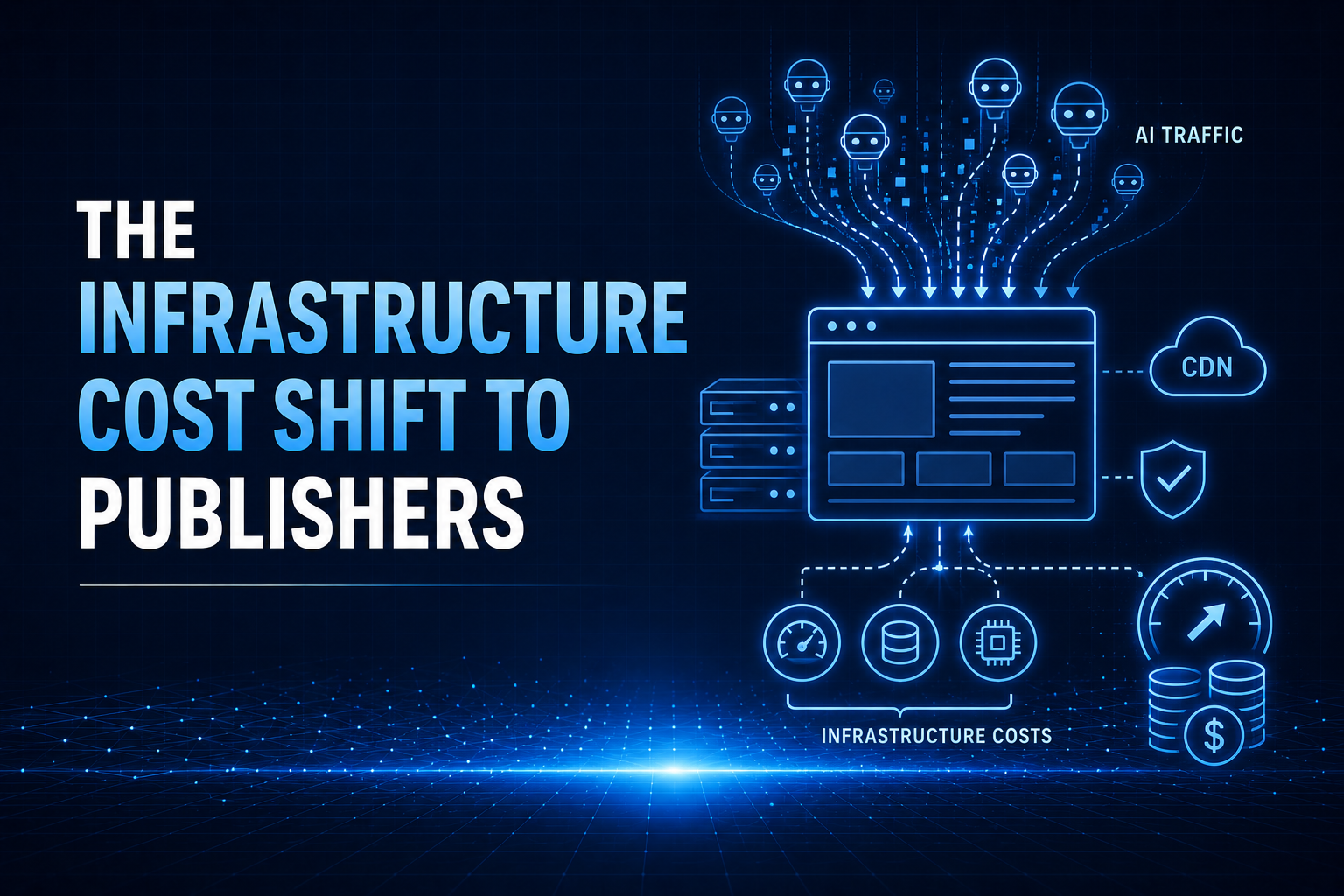
Running a content business has always involved infrastructure costs. Servers, bandwidth, content delivery networks, caching layers, security tooling — these are the operational expenses that sit beneath every article published and every page served. For most of the web's history, those costs scaled roughly in proportion to human readership, and human readership generated revenue through advertising, subscriptions, or commerce. The cost and revenue curves moved together, imperfectly but in the same direction.
AI has decoupled them. Machine traffic is now a significant and growing share of the requests hitting publisher infrastructure, but that traffic generates none of the revenue signals that the existing monetisation stack depends on. Publishers are serving more requests, absorbing more bandwidth, and managing more complex access patterns than they were three years ago, largely because of AI-related activity, and they are doing so without a corresponding increase in revenue to cover it.
That is the infrastructure cost shift. It is not a headline risk in the way that inference substitution or the scraping-to-revenue imbalance are. It does not produce a single visible harm that is easy to point to. It produces a slow, structural deterioration in unit economics that is easy to miss until it becomes impossible to ignore.
What the cost shift actually involves
The infrastructure cost shift to publishers has several components, and they operate at different layers of the technical stack.
The most direct is bandwidth and compute cost. Every request that hits a publisher's origin server or CDN consumes resources. AI crawlers and retrieval systems make requests at a rate and pattern that differs significantly from human browsing. A human reader loads a page, reads it, and moves on. An AI crawler may retrieve the same content repeatedly, fetch pages across an entire domain in rapid succession, or request content at volumes that a single human user would never approach. Cloudflare's analysis of AI bot traffic has documented the scale of this activity, with AI crawlers accounting for substantial and growing shares of total request volume for many sites.
The second component is security and access management overhead. As machine traffic grows, publishers need more sophisticated tooling to distinguish legitimate human visitors from automated clients, to identify which crawlers are compliant and which are not, and to enforce access policies that were never designed for this volume or variety of non-human traffic. Bot management, rate limiting, access logging, and traffic analysis all require engineering time and often third-party tooling that carries its own cost.
The third component is the operational complexity of managing AI-specific access at all. Publishers who want to participate in the licensed AI access market, rather than simply block all machine traffic, need infrastructure to publish machine-readable licensing terms, verify licensing status at the access layer, meter usage, and maintain audit records. Building that infrastructure from scratch is a significant engineering project. The alternative to building it is absorbing ongoing unpriced access, which is its own form of cost.
Why this cost shift is structurally different from ordinary traffic growth
Publishers have managed traffic growth before. A viral article, a major news event, or a successful SEO campaign can all produce spikes in request volume that strain infrastructure temporarily. Those spikes are costly, but they are also revenue-generating: more human visitors means more ad impressions, more subscription prompts, more commerce opportunities.
AI-driven traffic growth is different because it is structurally decoupled from revenue. A large increase in crawler traffic does not produce more pageviews, more sessions, or more conversions. It produces more infrastructure cost with no offsetting revenue signal. The unit economics of serving that traffic are therefore permanently negative under any existing monetisation model.
This is also why the cost shift compounds over time in a way that ordinary traffic growth does not. Human traffic fluctuates. AI crawler activity tends to be persistent and growing, because it is driven by the expansion of AI products and the increasing appetite of those products for fresh, high-quality content. Research on AI adoption trajectories consistently shows that AI system deployment is accelerating, which means the machine traffic hitting publisher infrastructure is likely to grow faster than human readership for the foreseeable future.
The compounding effect on smaller publishers
The infrastructure cost shift affects all publishers, but it is proportionally more damaging for smaller ones. A large media organisation with significant engineering resources and enterprise CDN contracts can absorb additional machine traffic more efficiently and can negotiate better rates for the tooling required to manage it. A regional publisher, an independent creator operating a subscription newsletter, or a specialised data provider does not have those resources.
For smaller publishers, the cost shift creates a direct threat to viability. Infrastructure costs that were sized for a human readership of a certain scale become inadequate when machine traffic adds a significant volume of requests on top. Scaling up infrastructure to handle that volume costs money. Failing to scale up risks performance degradation for human readers, which damages the product and the revenue it generates.
This is one of the less-discussed dimensions of the long-tail licensing problem that the AI era has introduced. Large publishers have the leverage to negotiate AI licensing deals that might eventually offset some of these costs. The long tail of smaller publishers does not, and they are absorbing the infrastructure burden of machine consumption without any of the potential upside from licensed access.
The relationship to the broader monetisation failure
The infrastructure cost shift does not exist in isolation. It is one component of a wider squeeze that the AI era has placed on content businesses, and it interacts with the other structural failures the market is now navigating.
The scraping-to-revenue imbalance describes the gap between machine access to content and the revenue that access generates. The inference substitution problem describes how AI-generated answers reduce the traffic that would otherwise monetise through existing models. The infrastructure cost shift describes how the same machine activity that creates those revenue failures also imposes direct operational costs. Together, they produce a three-sided squeeze: revenue from human traffic falls, revenue from machine traffic does not exist, and the cost of serving machine traffic rises.
For publishers whose economics were already under pressure before the AI era, this combination is severe. The margin available to absorb additional costs is thin. The mechanisms available to recover those costs through new revenue are still being built. The gap between the two is where the infrastructure cost shift does its damage.
Why the cost shift is an infrastructure problem with an infrastructure solution
The infrastructure cost shift is not going to be resolved by legal action or industry lobbying alone, because its causes are technical and its remedies are technical. The cost arises because machine traffic is unmetered, because access control systems were not designed to distinguish between different types of automated clients, and because there is no standardised path from machine consumption to publisher compensation.
Each of those causes points to an infrastructure solution. Metering machine traffic requires instrumentation at the access layer. Distinguishing compliant from non-compliant automated clients requires identity and authentication infrastructure that can operate at request speed. Creating a compensation path requires programmatic licensing standards that connect access events to payment triggers.
The good news is that this infrastructure is being built. RSL provides the standard for expressing machine-readable licensing terms. CDN-level enforcement tools can validate licensing status before content is served, which means compliant AI clients can be granted access while non-compliant ones are blocked or logged. Settlement infrastructure can connect metered access events to billing, so that the cost of serving licensed machine traffic is offset by the revenue that licensing generates.
Supertab Connect addresses the infrastructure cost shift directly by absorbing the operational burden of running this stack. Publishers who use it do not need to build or maintain an OAuth token server, edge enforcement logic, token lifecycle management, or access observability tooling. Those components are managed infrastructure. The publisher defines the licensing terms and the pricing, and the platform handles the technical layer that converts those terms into enforced, auditable, revenue-generating access control. For publishers who are currently absorbing the cost of machine traffic with no offsetting revenue, that is a direct improvement in unit economics.
What publishers should be measuring
One practical challenge the infrastructure cost shift creates is visibility. Many publishers do not have clear instrumentation on what share of their infrastructure costs are attributable to machine traffic, which makes it difficult to quantify the problem or make the business case for investing in a solution.
The starting point is access log analysis. Separating human sessions from bot and crawler traffic in server logs reveals the proportion of requests that are machine-originated and provides a baseline for understanding the cost exposure. Tools for bot traffic analysis are widely available and can be deployed without significant engineering investment.
Once the machine traffic share is understood, the next question is what that traffic is doing: which content is being accessed, at what frequency, by which automated clients, and under what terms if any. That analysis is the foundation for a licensing strategy, because it identifies where the highest-value machine consumption is occurring and where the compensation gap is largest.
What the cost shift means for the AI content market
The infrastructure cost shift matters beyond individual publisher economics because it shapes the conditions under which the AI content market will develop. If publishers cannot sustain the cost of serving machine traffic without compensation, they will either block AI access entirely or reduce their investment in the content production that makes their material valuable to AI systems in the first place.
Neither outcome is good for the AI industry. AI systems that lose access to high-quality, current, professionally produced content become less useful. The training data and retrieval inputs that distinguish capable AI products from mediocre ones depend on a healthy content ecosystem. That ecosystem is sustained by publisher economics. If the infrastructure cost shift continues to erode those economics without a compensating revenue mechanism, the content quality that AI companies depend on will gradually decline.
This is why the infrastructure cost shift is not just a publisher problem. It is a market equilibrium problem. The AI content market needs publishers to remain viable, and publishers need the AI content market to develop compensation mechanisms that reflect the real cost of machine access. The infrastructure to support that equilibrium exists. The question is how quickly it becomes standard practice across the market.


