
What is a license.xml file, and what goes in it?
Where the file sits and how a crawler finds it
The usual location is /license.xml at the root of your domain. That is where the Supertab WordPress plugin publishes it. Crawlers look there by convention, as they do for robots.txt.
The standard also supports 2 other formats. You can include terms in an RSS feed using the RSL namespace, or embed them in a page's HTML with a script or link tag. The latter suits terms for individual pages. Most sites use a single file for the whole domain.
What's inside
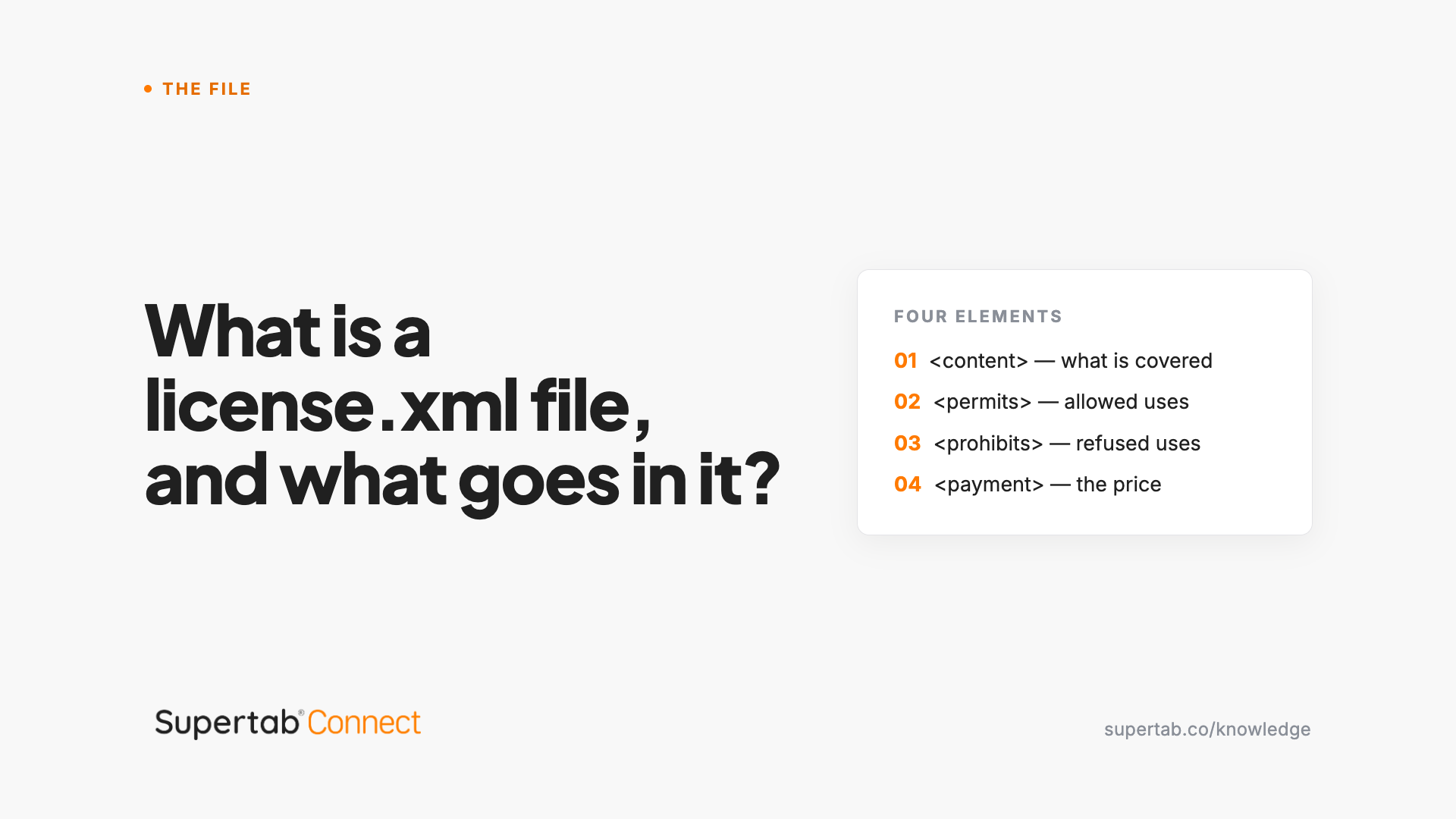
Four elements carry most of the information.
<content> identifies what the licence covers. It accepts a URL path, so your archive and news section can have different terms. <permits> lists allowed uses and <prohibits> lists prohibited ones. <payment> gives the cost of permitted uses, with a type and an <amount>.
Supporting elements include <copyright> for the rightsholder, <legal> and <terms> for additional legal wording, and <reporting> for usage reporting requirements. Use <standard> to reference an existing licence rather than write your own.
The vocabularies are what make it machine-readable
RSL can be parsed because its values come from fixed lists. Free text alone would leave a crawler with the same interpretation problem as a terms page.
Usage tokens distinguish the activities: ai-train for training, ai-input for a model reading a page to answer a live question, ai-index and search for indexing, and ai-all or all for broader coverage. User tokens include commercial, non-commercial, education, government and personal. They let you price the same content differently according to who is asking. Payment types include free, attribution, crawl, use, training, subscription and purchase.
Those defined values let a crawler interpret the terms without guessing what you meant.
You probably won't write it by hand
You can write the file yourself. It is short XML, and the specification at rslstandard.org includes examples.
Most publishers use a tool. Once you enter your Website URN, the free Supertab WordPress plugin publishes and maintains the file. The terms you set in the dashboard become valid XML at the expected address. That consistency matters when other people's software needs to parse the result.
Keep it current, and date it
Prices and covered paths change. The vocabulary will also grow as the standard develops.
Review license.xml whenever you change pricing or restructure URLs. Check that the tool responsible for it is still generating the file. Treat it as a published policy: someone may rely on the terms, which makes an outdated file worse than no file.


