
Why Infrastructure Players Are Becoming Economic Gatekeepers
For most of the internet's history, infrastructure was supposed to be neutral. A content delivery network moved bytes. A firewall blocked attacks. An identity provider confirmed logins. These were plumbing, valued for reliability and speed, and they did not decide the commercial terms of what flowed through them. The businesses that made money from the web, publishers, retailers, platforms, sat on top of the infrastructure and set their own terms directly with their customers.
AI has inverted that relationship. When the customer is a machine acting at scale, the terms of access have to be set and enforced at the point where the machine's request arrives, which is the infrastructure layer. The control point for AI access is moving upstream, toward the infrastructure companies that sit between users, bots, and web content, because that is the only place a request can be identified, evaluated, and priced before it reaches the origin. The plumbing has become the tollgate.
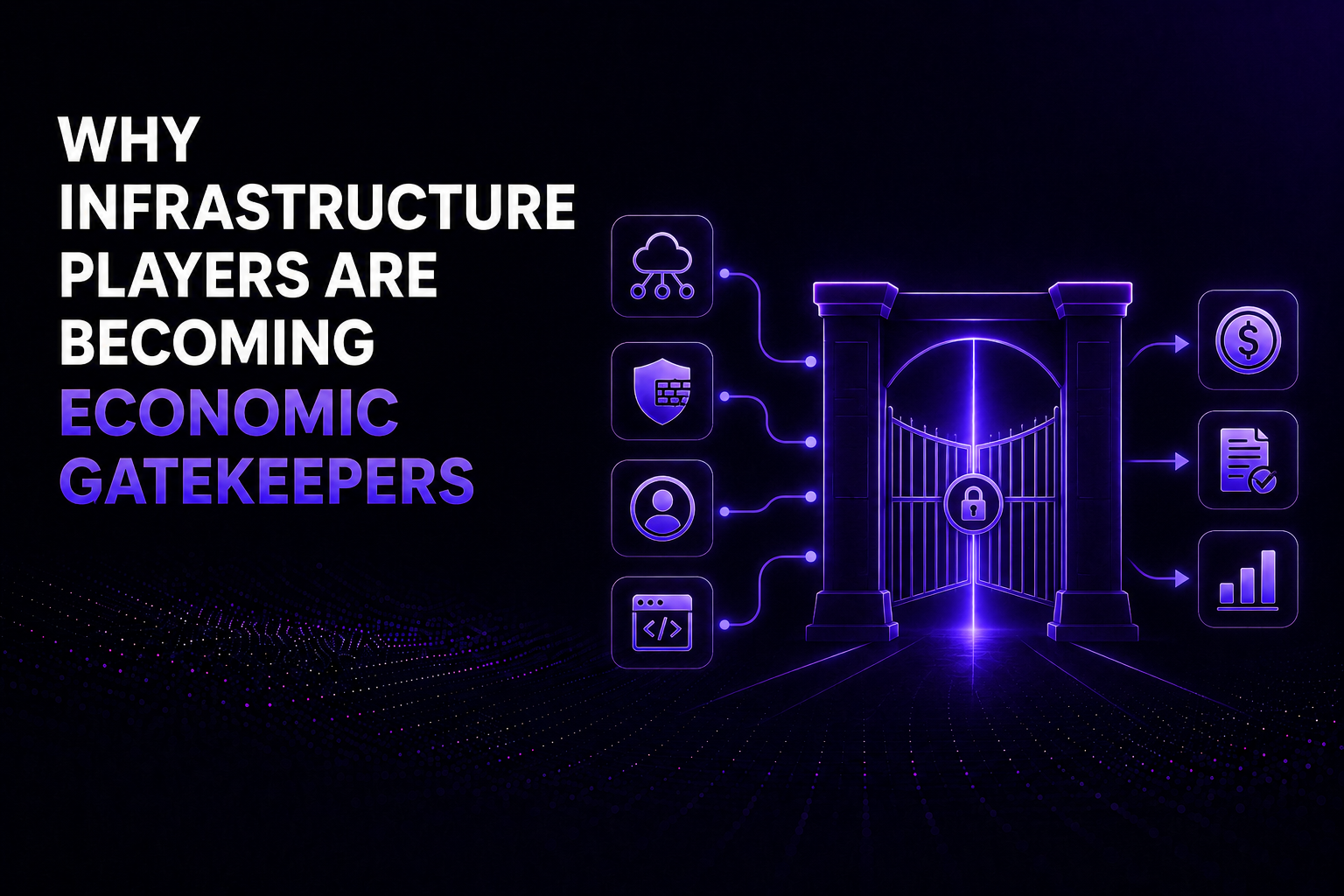
This is the throughline connecting every infrastructure player reshaped by AI. The CDN deciding whether to serve a crawler, the firewall filtering an agent, the identity provider verifying an actor, the API platform gating a call, the payment processor settling a machine transaction, the data marketplace licensing access. Each sits at a chokepoint where machine access is controlled, and control over access is becoming control over commerce. The revenue logic of the entire infrastructure stack is shifting from selling capacity and protection to governing and pricing the access that runs through it. Whoever holds those chokepoints holds economic power that used to belong to the content and service owners themselves.
Why access became the thing worth controlling
The reason infrastructure gained this power is that AI changed what is scarce. When human attention was the scarce resource, the businesses that captured attention held the power, and infrastructure merely delivered their content faster. When machine access to content and data became the scarce, contested resource, power moved to whoever controls that access.
The scale of machine consumption is what forced the shift. Automated traffic now exceeds human traffic on the open web, and the old bargain that justified free access, crawling in exchange for referral traffic, has broken down to the point where one major AI company crawls thousands of pages for every visitor it sends back. When access is being taken at that volume and returning nothing, the ability to gate that access becomes valuable in itself. The infrastructure layer, which was always positioned to gate, suddenly had something worth gating.
Data is the clearest case. It is the raw material of AI, and its value has made access to it the decisive competitive input. As one analysis of AI market structure put it, if access to essential data becomes restricted through proprietary formats, lack of interoperability, or exclusionary licensing, competition inevitably stalls. Whoever controls access to data controls who can build competitive AI, and increasingly that control lives in the infrastructure that sits in front of the data rather than with the data's owner. This is the same dynamic we traced through data marketplaces, where the platform intermediating access captures more durable value than the party selling the dataset.
Gatekeeping power is already concentrating
The uncomfortable part is that infrastructure is concentrated by nature. A handful of CDNs carry much of the web's traffic. A small number of cloud providers host much of its compute, with roughly two-thirds of the world's cloud capability controlled by three companies. When economic gatekeeping power attaches to layers that are already concentrated, the result is a small number of firms with outsized influence over the terms of AI access across the whole web.
This is visible in how the most advanced monetization gatekeeping is being built. A single provider sitting in front of a large share of the web can offer to identify agents, enforce permissions, meter usage, and settle payment all at once, which is genuinely useful to content owners drowning in uncompensated crawling. But it also concentrates all four functions in one intermediary, and observers have warned that this lets one company control the identification of agents, the permissions layer, the usage measurement, and the payment infrastructure simultaneously. Content owners gain leverage over AI companies while deepening their dependence on the gatekeeper that now stands between them.
The historical rhyme is hard to miss. The open internet era eventually produced its own gatekeepers, the search engines and platforms that mediated discovery and set the terms for everyone downstream. The risk now is reproducing that pattern one layer down, letting the firms that already control computing power, data, and distribution use those same assets to become the gatekeepers of AI access. The concern raised at the policy level is precisely that AI could reproduce the same gatekeeping dynamics that the open internet spent decades trying to constrain, only with higher stakes because the resource being gated is the raw material of the next economy.
The friction between necessary gatekeeping and captured markets
Some gatekeeping is not only unavoidable but desirable. Someone has to identify machine traffic, enforce terms, and settle payment, or the AI economy has no way to compensate the people whose content and data it runs on. The problem is not that gatekeepers exist. It is the terms on which they hold the gate.
Every stakeholder feels this tension. Content and service owners want the gatekeeping that lets them get paid, but not a gatekeeper that captures them, takes a controlling position between them and their customers, and dictates terms they cannot refuse. AI companies want reliable access under clear rules, but not a landscape where each concentrated gatekeeper imposes its own scheme, forcing bespoke integration and bespoke fees at every chokepoint. Smaller players on both sides want the leverage that infrastructure-level enforcement provides without trading independence for it. Regulators, watching essential access concentrate, are beginning to treat these chokepoints as matters of market structure rather than mere plumbing.
The resolution is not to eliminate gatekeeping but to change its character, from proprietary control to open infrastructure. A gatekeeper that operates on open standards, where terms, metering, and settlement are expressed in formats any provider can implement and any participant can read, still performs the necessary function of governing access without owning the market that runs through it. The difference between a tollgate on a public road and a private road that only one company operates is the difference between infrastructure that serves the market and infrastructure that captures it. This is why machine-readable licensing as an open standard matters so much: it lets the gatekeeping function exist without concentrating it, because the terms travel with the content rather than living inside one provider's system.
Building the gate without owning the market
The way to keep gatekeeping open is to separate the function from the operator. The capabilities that make an economic gatekeeper, expressing terms, verifying identity, metering usage, settling payment, can be built as interoperable infrastructure that many providers connect to, rather than as a closed system that one provider controls. When those capabilities run on shared standards, a content owner can move between providers, an AI company can meet the same terms everywhere, and no single intermediary becomes the mandatory toll on all machine access.
This is the design principle behind programmatic licensing built on open standards rather than proprietary rails. The point is not to prevent anyone from operating a gate, but to ensure the gate is one the whole market can build on and pass through on equal terms. Infrastructure that governs access without capturing the participants is what lets the AI economy have the compensation gatekeeping enables without the dependence it threatens.
Supertab Connect is built on that principle. It gives content and service owners the gatekeeping capabilities the AI economy requires, machine-readable terms, identification of the consuming party, metering, and automated settlement, on open standards that connect to the enforcement points already in place rather than locking participants into a single network. The aim is to let a content owner be an economic gatekeeper of its own content, setting and collecting on its own terms, instead of surrendering that role to whichever concentrated intermediary sits in front of it. Gatekeeping over your own access, held by you rather than extracted from you, is the version of this shift worth building toward.
The Question Is Not Whether Gates Exist, but Who Holds the Keys
Infrastructure players are becoming economic gatekeepers because AI moved the point of commercial control to the layer they occupy. This is not a temporary distortion. As long as machines consume content and data at scale, the terms of that consumption will be set where the machine's request is identified and priced, and that is the infrastructure layer. Gatekeeping is now part of what infrastructure does.
The consequential choice is not whether to have gatekeepers, because the AI economy needs someone to govern and price access or no one gets paid. The choice is whether that gatekeeping concentrates in a few firms that own the gate and the market behind it, or runs on open standards that let the function exist without the capture. The infrastructure players that build closed tollgates will accrue real power and real dependence, until the market and its regulators push back on both. The ones that build open, interoperable gates will enable the same compensation without becoming the chokepoint everyone resents and eventually routes around. The keys to AI access are being cut right now. Who ends up holding them, one intermediary or the participants themselves, is the structural question that will define the next era of the web.


