
Why Ads Break in AI Interfaces
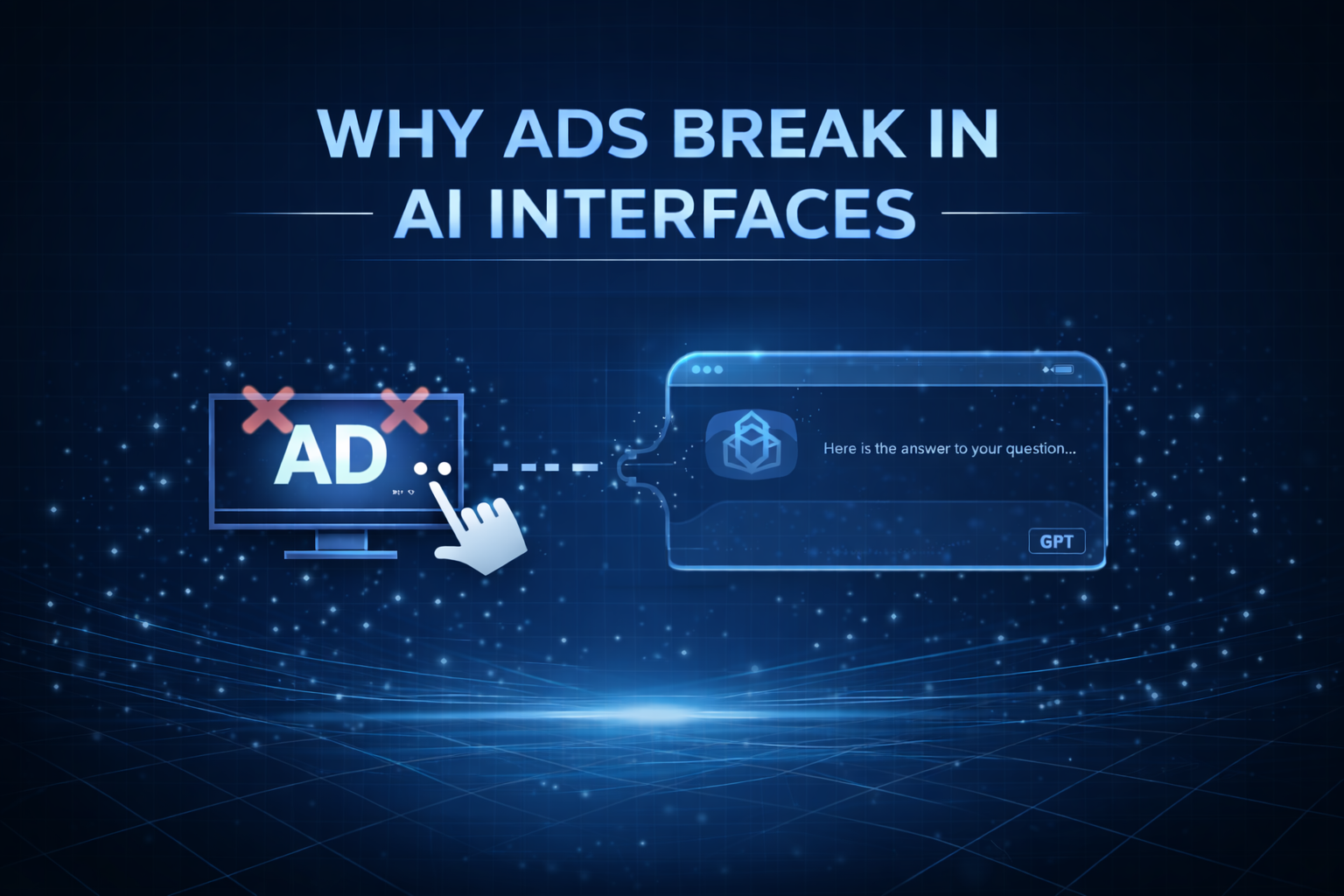
Advertising worked on the consumer internet because people moved through pages, feeds, and search results. Each step created space for sponsored placement. Each pause created another chance to monetize attention. AI interfaces change that structure. Instead of navigating, users increasingly ask for an output and expect the system to deliver it directly.
That shift matters economically because the old ad model depended on expansion. A user searched, scanned, clicked, compared, and clicked again. Generative AI collapses those steps. Google itself has framed this transition as part of search moving into AI Overviews and AI Mode, while also confirming that it is now bringing ads into AI Overviews and AI Mode. The fact that those ad products need to be reintroduced inside the AI layer is the point: the old ad container no longer comes naturally with the interface.
This problem sits directly on top of the argument we made in ‘The Monetization Gap in Generative AI’. There, we defined the broader structural failure between AI usage and AI revenue. Here, the focus is narrower: why the interface itself no longer behaves like a strong advertising environment.
The ad model was built for navigation
Traditional digital advertising thrives when users move across multiple units of content. A search engine results page contains links, snippets, sponsored listings, and commercial options. A publisher page contains display inventory, related links, recommendations, and retargeting hooks. A social feed creates repeated moments for insertion between items.
AI interfaces weaken that architecture because they are designed to remove steps rather than multiply them. The better the system is at summarizing, resolving, and executing, the fewer intermediate moments remain available for monetization. In other words, product quality and ad opportunity begin to move in opposite directions.
This is why ads break in AI interfaces. The issue is not that ads become impossible. The issue is that the interface no longer naturally generates the volume, spacing, and user behavior patterns that made ads work so well on the earlier web.
The answer becomes the destination
In a classic search environment, the query often begins a journey. In a generative AI environment, the query is increasingly supposed to end one.
That distinction matters. If a user asks for a recommendation, a summary, a comparison, or a plan, and the model provides a satisfying answer immediately, the interface has done its job. But from an ad perspective, that same success can erase the monetizable path that used to sit between question and resolution.
OpenAI’s research on how people are using ChatGPT shows that usage is strongly tied to practical tasks, including work-related use, learning, writing, and problem solving. That pattern reinforces the issue. These are not idle scrolling environments. They are increasingly utility environments, and utility interfaces are harder to monetize through interruption because the user is there to complete a task, not to browse around one.
Ads also sit awkwardly inside trust-based interfaces
There is another reason ads break in AI interfaces. Generative systems ask the user to treat the interface as an assistant, not just a media surface. The product is positioned as something that helps interpret a problem, recommend an answer, and guide a decision.
That creates a trust burden that is different from a feed or results page. Once the model appears to be choosing what matters, any commercial insertion risks feeling less like an ad and more like manipulation. The closer the interface gets to recommendation, synthesis, or action, the more sensitive the placement becomes.
This does not mean sponsored outputs can never work. It means they are harder to integrate without damaging confidence in the system. An ad on a page is one thing. A monetized suggestion inside a supposedly intelligent answer is something else.
AI also weakens the economics of traffic generation
Ads do not only monetize attention inside interfaces. They also rely on downstream traffic. Search sends people to publishers. Discovery sends people to websites. Websites then monetize visits through display, affiliate, sponsorship, or conversion.
AI interfaces can reduce that traffic flow because they increasingly answer before the click. If the user receives the summary, extraction, or recommendation in the AI layer, fewer visits reach the source layer. That makes the ad problem larger than interface design alone. It can erode the economics of the open web around the interface as well.
This is one reason the problem is so important for publishers, data providers, and SaaS platforms. When AI captures user intent early and resolves it internally, the old advertising chain becomes less reliable both for the interface owner and for the content ecosystem feeding the interface.
The cost side moves the wrong way too
The advertising mismatch would be easier to tolerate if AI interfaces were cheap to run. They are not. Major model providers continue to price usage around runtime consumption. OpenAI’s API pricing and Claude pricing both reflect ongoing inference costs rather than one-time software delivery. That means the business model around AI has to do more than support a user interface. It also has to absorb variable compute economics.
This is where the failure becomes especially sharp. The interface creates less natural ad inventory at exactly the moment the underlying product becomes more expensive to serve. On the old web, more engagement often meant more ad opportunity. In AI, more usage can mean more cost without a matching expansion in monetizable space.
Why this is a structural problem, not a temporary design challenge
It is easy to assume the market will solve this with better ad formats. Some of it will. Google is already experimenting with exactly that inside AI search experiences. But the bigger problem is not format design. It is architectural.
Ads fit interfaces that are built around discovery, exploration, and repeated exposure. They fit less naturally in interfaces built around compression, completion, and direct resolution. Generative AI is not just a new channel with slightly different placements. It changes the relationship between intent, interface, and outcome.
That is why we see this as part of a broader monetization transition rather than a narrow product tweak. If the interface is optimized to answer, execute, and reduce friction, then monetization has to move closer to the event of value itself. It cannot rely only on the surrounding attention surface.
Why a different model becomes necessary
The more AI interfaces succeed, the more they push the market toward monetization models that do not depend on interruption. That is why usage-based pricing, machine-readable licensing, access control, and transaction-native infrastructure matter so much.
If an AI system retrieves licensed content, calls a premium tool, executes a workflow, or delivers a high-value result, the commercial model should attach to that event. That is a very different logic from hoping there is enough spare space around the interaction to display something sponsored.
McKinsey’s 2025 State of AI survey points in the same direction at the enterprise level: adoption is broad, but scaled financial impact remains harder to achieve than the excitement around deployment might suggest. That gap is exactly why we keep arguing that the internet needs a third monetization model for AI-era products and services.
What it means when ads break in AI interfaces
Ads break in AI interfaces because the interface is no longer organized around the behaviors that made digital advertising powerful. There are fewer pages, fewer pauses, fewer clicks, and fewer natural insertion points. The user wants an answer, not a browsing session. The system is designed to compress intent into resolution, not to stretch intent across monetizable inventory.
That does not mean advertising disappears. It means advertising loses its position as the default economic layer for the interface. As AI systems become more utility-driven, more trust-sensitive, and more expensive to operate, revenue has to come from somewhere closer to the actual event of value.
That is the structural problem. The better AI gets at removing friction, the worse the old ad model fits the experience. And that is why ads do not just weaken in AI interfaces. They break.


