
What Is Per-Request Pricing?
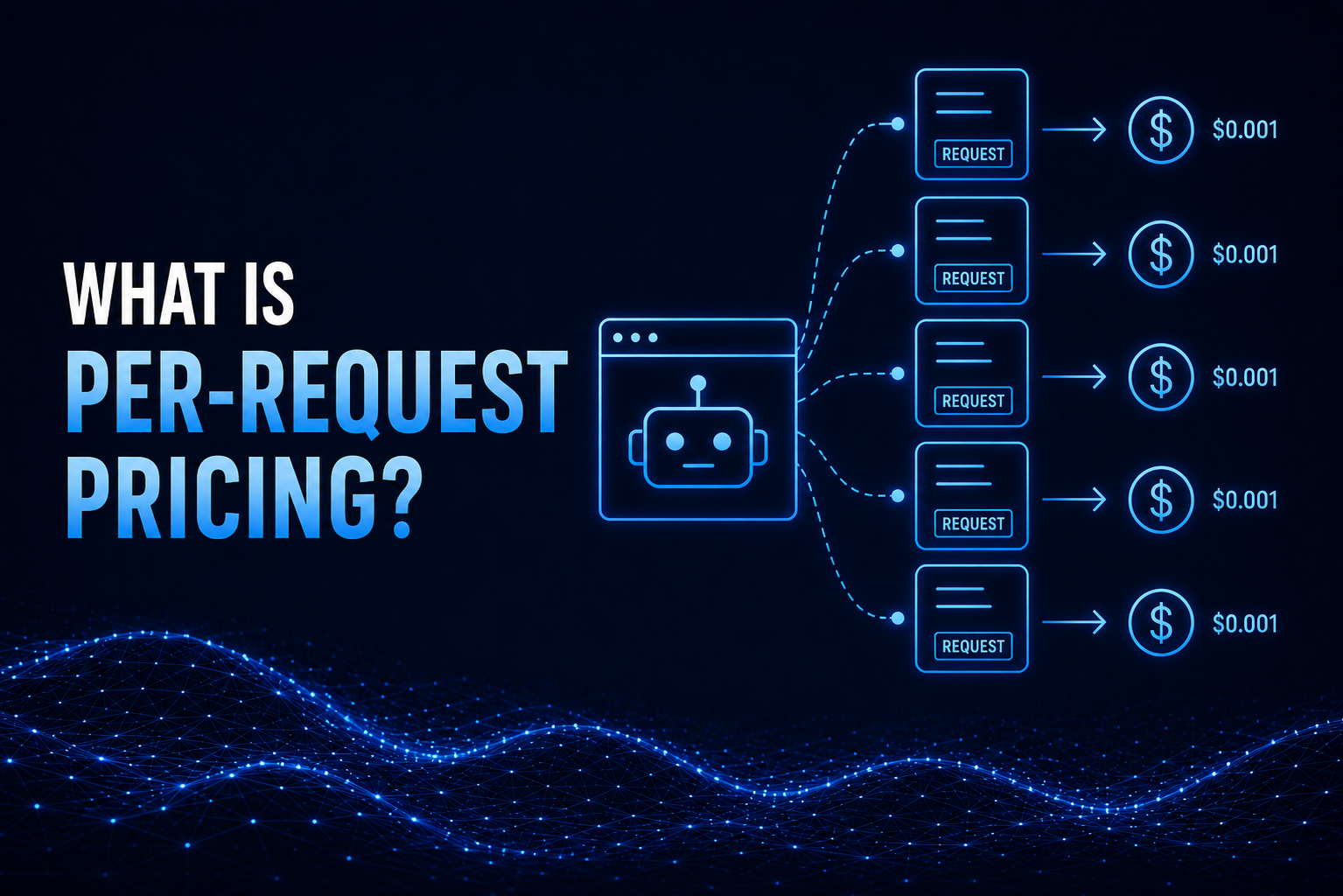
When an AI agent retrieves an article, calls an API, or triggers a licensed action, that action is a discrete event. Per-request pricing attaches a set price to that event and charges it each time the event occurs. If a request costs a tenth of a cent, then a thousand requests cost a dollar, and the arithmetic is that simple by design. The price does not vary with how much data the request returns or how much work it involves. The request is the unit, and the unit has a price.
This model matters in the AI economy because machine activity is fundamentally request-shaped. Agents and models interact with content and services through discrete calls, and the number of those calls is where cost and value both accumulate. A pricing model that attaches directly to the request aligns what is charged with what actually happens, which is the core requirement of any usage-based approach. Per-request pricing is the most direct expression of that alignment, because there is no layer of abstraction between the billable event and the thing being billed.
What per-request pricing actually means
Per-request pricing charges a predetermined amount each time a request is made, with the request itself as the billable unit.
The defining feature is the fixed price per call. Whether a given request returns a short answer or a long one, touches a small resource or a large one, the price is the same, because the price is set against the act of requesting rather than the substance of what is returned. This is what makes it the simplest usage-based model to reason about. A party considering a request knows exactly what it will cost before making it, and a party granting the request knows exactly what it will earn. There is no estimation and no reconciliation after the fact.
This simplicity is also what distinguishes per-request pricing from the token-based pricing common among model providers. Token-based pricing charges according to the volume of data processed within a call, so the cost of any given request depends on how much text goes in and comes out. That aligns price tightly to compute cost, but it makes the cost of an individual request hard to predict in advance, because the requester cannot always know how large the response will be. Per-request pricing trades that fine-grained cost alignment for predictability. It says that every request costs the same, which is easier to understand even if it is a blunter instrument. The two models answer different questions: token-based pricing asks how much work the request involved, while per-request pricing asks only whether the request happened.
Why per-request pricing fits machine access
Per-request pricing suits AI-era access because the request is already the natural unit of machine interaction. Agents do not browse or subscribe. They call.
When an autonomous system does its work, it generates a stream of discrete requests: a retrieval here, an API call there, a licensed lookup somewhere else. Each is a self-contained event with a clear beginning and end. Pricing that unit directly means the economic model matches the operational reality, which is exactly the alignment that usage-based monetization for AI is built to achieve. The request is where value is exchanged, so the request is a sensible place to attach a price.
This fit is especially strong for content and licensed access, as opposed to raw model inference. When an AI system retrieves a licensed article or accesses a specific piece of content, the meaningful unit is the access event itself, not the number of words in the article. A publisher licensing content to AI systems often cares about how many times its content is accessed, which is a per-request question. This is why the emerging infrastructure for charging AI crawlers has gravitated toward per-request models. Cloudflare's pay-per-crawl approach, for instance, lets a content owner set a price that is charged each time a crawler accesses a page, which is per-request pricing applied directly to machine content access. The request to fetch the page is the billable event, and it carries a fixed price.
The advantages of pricing by the request
The central advantage of per-request pricing is the tight coupling between cost and activity. Every request is paid for, and nothing else is, which produces a clean economic relationship on both sides.
For the party being paid, revenue scales directly with usage. More requests mean proportionally more revenue, with no gap between how much the content or service is used and how much it earns. This is the alignment that flat models lack, where heavy use and light use can pay the same. Per-request pricing removes that mismatch by construction, because the only thing that generates a charge is a request, and every request generates one. This is the same principle that makes per-request pricing so well aligned on cost: a provider structuring the price as a markup on the underlying cost of serving a request never loses money on a request, because the price is set against the thing that incurs the cost.
For the party paying, the advantage is transparency. The cost of an action is known in advance and is easy to reason about. A fixed price per request is the most legible pricing there is, because it requires no forecasting of volume or size. This legibility matters more for machines than it might for humans, because an agent operating under a budget needs to evaluate the cost of an action before taking it. A predictable per-request price is something an agent can factor into a decision cleanly, which is part of why this model suits agent-to-agent commerce, where a requesting system must weigh cost against value programmatically before it acts.
The limits of per-request pricing
The same simplicity that makes per-request pricing attractive also creates its main weakness: a fixed price per request can misprice requests that differ greatly in cost or value.
If some requests are far more expensive to serve than others, a single flat price either overcharges the cheap ones or undercharges the expensive ones. A model that returns a one-line answer and one that returns a large document cost the provider very different amounts, yet per-request pricing charges the same for both. Where that variance is large, the flat price becomes a poor fit, which is precisely the gap that token-based and other volume-sensitive models exist to close. Per-request pricing is strongest when requests are reasonably uniform in cost, and weakest when they are wildly variable.
The more serious challenge is unpredictability of the total bill, which is the mirror image of the per-request predictability. While the cost of a single request is perfectly clear, the cost of many requests depends on how many are made, and at machine speed that number can climb fast. A misconfigured process or a runaway loop can generate an enormous volume of requests in a short time, and under per-request pricing each one is billable. The industry has learned this the hard way, where a runaway workflow can turn a small expected bill into a very large one overnight. This is why per-request pricing in practice is usually paired with controls: spending caps, rate limits, and budgets that bound the worst case. The predictability of the unit does not guarantee predictability of the total, and a workable per-request system has to manage that gap.
There is also the problem of transaction overhead, which is not about the price but about the cost of collecting it. A request might be worth a fraction of a cent, but settling that fraction of a cent individually can cost more than the charge itself. This is a real constraint on per-request pricing at the smallest scales, and it is why per-request pricing depends on settlement infrastructure that can handle tiny amounts economically. Without a way to aggregate many small per-request charges into a settleable sum, sub-cent per-request pricing does not work, no matter how sensible the per-request logic is.
Where per-request pricing fits among other models
Per-request pricing is not the only way to price usage, and it is often best understood as one option among several that suit different situations.
Token-based or volume-based pricing fits where the cost of a request varies significantly with its size, because it tracks that variance directly. Threshold-based billing, where usage accrues and is charged when it crosses a set level, fits where individual requests are too small to settle one by one and need to be batched. Subscription or platform-fee models fit where a party wants predictable periodic cost and is willing to trade precise alignment for that predictability. Per-request pricing occupies the position of maximum granularity and maximum transparency, best suited to discrete, reasonably uniform access events where knowing the exact cost of each action matters.
In practice these models are often combined rather than chosen exclusively. A system might use per-request pricing for content access while metering model usage by volume, or pair a per-request rate with threshold-based settlement so that many small charges aggregate before payment. The point is not that per-request pricing is universally best, but that it is the clearest tool for a specific and common job: putting a known price on a discrete machine request. It is a foundational piece of the broader third monetization model, which treats usage-based, transaction-native pricing as the way to monetize an AI-era web, and per-request pricing is the most elemental form that pricing can take.
What per-request pricing comes down to
Per-request pricing charges a fixed amount for each request, making the individual call the unit of payment. It is the simplest and most transparent usage-based model, because the price is known in advance and attaches directly to the discrete events that make up machine activity.
Its strengths are alignment and clarity: revenue tracks usage exactly, and the cost of any single action is knowable before it is taken, which suits the request-shaped nature of AI access and the budget-aware logic of autonomous agents. Its limits are the flip side of that simplicity: a flat price fits poorly when requests vary widely in cost, the total bill can climb unpredictably at machine speed without spending controls, and the smallest charges only work when settlement can aggregate them economically. Per-request pricing is not the answer to every pricing question, but it is the most direct answer to the most basic one, which is how to put a price on a single machine request. That makes it the natural starting point for understanding how AI-era usage gets priced at all.


