
What AI Monetization Means for Retrieval-Augmented Systems
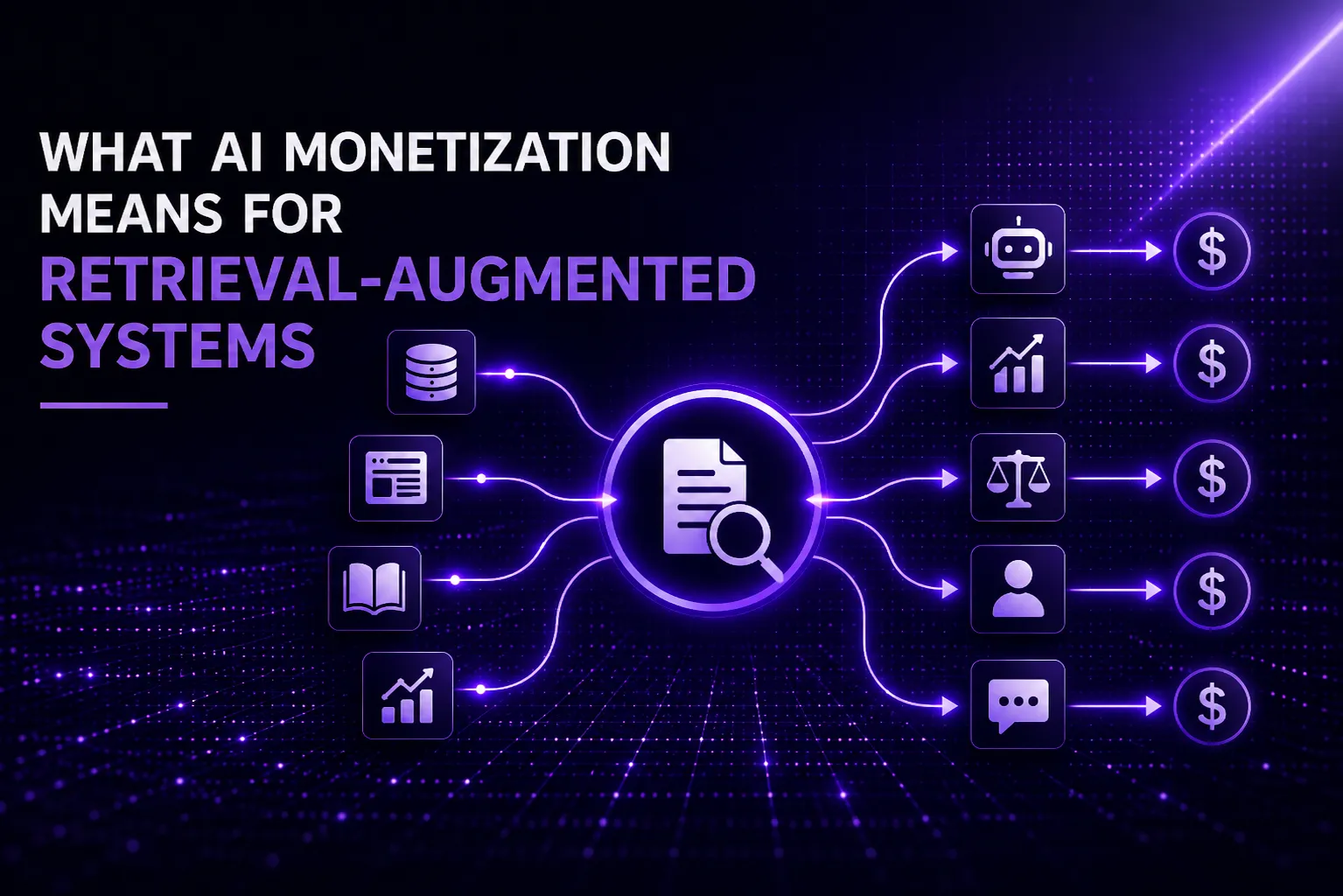
Retrieval-augmented generation, commonly referred to as RAG, is an architectural pattern that has become central to how production AI systems are built. Rather than generating responses from parametric memory alone, RAG systems query external knowledge sources at inference time, retrieve relevant material, and incorporate it into the output. The result is an AI product that can answer with current, specific, and verifiable information rather than relying on what was absorbed during a training run that may be months or years out of date.
That architecture is now widespread. Enterprise search tools, AI assistants, customer support platforms, legal research products, financial analysis copilots, and general-purpose chat interfaces all increasingly rely on some form of retrieval augmentation. Research from institutions including IBM on RAG architecture and industry documentation from NVIDIA on RAG pipelines illustrate how quickly the pattern has moved from academic concept to production standard.
The economic implications of this shift are significant and largely unresolved. RAG systems depend on external content in a way that static training does not. When a model retrieves a document, a data record, a news article, or a research summary to construct a response, it is consuming that content at the moment of use. That is a fundamentally different relationship with content than training ingestion, and it requires a fundamentally different licensing framework to match.
Why RAG changes the content dependency problem
Training-based AI systems acquire knowledge from large datasets assembled in advance. The licensing question is difficult, but it is at least bounded: what data was used, when, and under what terms. Retrieval-augmented systems introduce a continuous dependency. Every query that triggers a retrieval event is a new instance of content use. The system may retrieve from the same sources thousands or millions of times per day, each time incorporating external material into an output that a user receives and acts on.
This matters because most existing content licensing frameworks were not designed for this pattern. A publisher that negotiated a training data agreement with an AI company addressed one commercial relationship at one point in time. RAG retrieval is different because it is ongoing, variable in frequency, and tied to the commercial value the AI product generates at the moment of inference. If the retrieval system uses premium financial data to answer investor queries, or pulls from specialist medical literature to inform clinical decisions, the content provider is contributing material value to a product at the exact moment that product earns revenue. The economic alignment problem is clear.
The distinction between training and retrieval is one reason programmatic licensing has become increasingly relevant to how AI content access is discussed at the infrastructure level.
The content quality problem creates pricing leverage
RAG systems are only as good as the sources they retrieve from. A general-purpose web crawl may work for broad informational queries, but it produces unreliable results for high-stakes use cases. Legal professionals, financial analysts, healthcare operators, and enterprise research teams expect accurate, current, verifiable outputs. That requires access to credible, structured, high-quality content rather than aggregated public data.
This is where content quality becomes a source of commercial leverage. Publishers of premium content, whether financial data providers, scientific journals, trade publications, or specialist archives, hold assets that RAG systems need because accuracy matters to the end user. The Reuters Institute Digital News Report consistently documents how trust and credibility remain central to why users choose certain information sources. That trust does not disappear when the user is accessing information through an AI interface. It transfers to the AI product that retrieves from credible sources, which means the credibility premium the content provider has built still carries economic weight.
Content providers that understand this are in a stronger negotiating position than those that treat retrieval licensing as a purely defensive question. The question is not only how to prevent uncompensated retrieval. It is how to price access to content that makes AI products more accurate, more trustworthy, and therefore more commercially viable.
Retrieval introduces interaction-level economics
Training data licensing typically involves a negotiated fee for access to a dataset over a defined period. Retrieval is structurally different because use is continuous, variable, and tied to specific outputs. A query that retrieves three documents from a premium source generates a different kind of value event than a query that retrieves nothing useful. This creates the conditions for interaction-level pricing, where compensation is tied to individual retrieval events rather than aggregated dataset access.
Interaction-level pricing is more complex to implement but better aligned with the actual economics of RAG systems. It creates a direct relationship between content use and content compensation. It also allows content providers to price differently based on the type of retrieval, the commercial context, or the downstream use case. A retrieval event that supports a free consumer query carries different value than one that informs a paid enterprise research product.
This pricing logic is already visible in adjacent markets. Usage-based monetization models across digital services have established that interaction-level billing is operationally achievable at scale when the right infrastructure is in place.
The infrastructure gap is the central problem
Interaction-level retrieval economics require three capabilities that most content providers do not currently have.
The first is machine-readable rights expression. RAG systems are automated. They do not pause to review terms of service before retrieving a document. If usage permissions are expressed only in human-readable legal language, automated systems cannot interpret them reliably, and ambiguity tends to favor the party with more resources. Rights need to be encoded in a format that retrieval systems can read and act on at request time. The Really Simple Licensing standard addresses this by enabling structured, machine-readable rights declarations that automated systems can interpret without human intervention.
The second is monitoring and access transparency. Content providers cannot price what they cannot see. If a RAG system is retrieving from a publisher's archive thousands of times per day, the publisher needs visibility into that activity, broken down by source, frequency, and context. Without that data, there is no basis for pricing, negotiation, or enforcement. Monitoring is not only a compliance requirement. It is the prerequisite for any rational commercial strategy around machine access.
The third is programmatic settlement. Once retrieval is permitted and measured, compensation needs to flow automatically. Manual invoicing does not scale to the frequency of retrieval events in a live AI system. The settlement layer needs to operate at machine speed, triggering payments based on verified usage without requiring human action on either side of the transaction.
These three requirements, rights expression, usage monitoring, and programmatic settlement, are the same infrastructure components that publishers have needed across every AI monetization context. The difference with RAG is that retrieval makes each individual content use more clearly attributable, which means the infrastructure can be more precisely calibrated to actual value.
Supertab Connect is built around this problem, providing the managed layer that allows content providers to define access terms, enforce them at the edge, and connect usage to settlement without building the underlying infrastructure themselves.
Cross-stakeholder friction increases at the retrieval layer
RAG systems sit at the intersection of several stakeholder groups with conflicting incentives, and the retrieval layer is where those conflicts become most concrete.
AI application builders want reliable, high-quality retrieval at low cost because retrieval quality directly affects product quality, and retrieval cost directly affects margins. As covered in the economics facing AI startups and application builders, the pressure to manage variable inference and data access costs is already significant, and retrieval licensing adds another layer of cost complexity.
Foundation model providers that offer RAG capabilities as part of their products need to manage content relationships at a scale that bilateral negotiation cannot support. The data access challenges facing foundation model providers are directly connected to retrieval because the freshness and accuracy that RAG enables is also what drives demand for licensed access to premium sources.
Content providers, particularly publishers and data companies, want compensation that reflects how much retrieval activity their material supports. They also want visibility and control, because allowing open retrieval without a settlement mechanism is effectively subsidising AI products that may be displacing their own direct distribution channels.
Regulators are beginning to engage with these questions too. The EU AI Act and evolving copyright frameworks in multiple jurisdictions are increasingly focused on transparency around how AI systems use external content, including at the retrieval layer. The regulatory direction reinforces the commercial case for structured retrieval licensing rather than assuming open access as the default.
The grounding layer carries disproportionate commercial weight
One underappreciated aspect of RAG economics is that the content used for retrieval grounding carries more influence over AI output quality than its volume might suggest. A retrieval system that pulls from three highly credible, structured sources to answer a question produces a materially better output than one pulling from a hundred low-quality pages. This means that for premium content providers, the value of their material in a RAG context can be disproportionately high relative to the volume of content accessed.
That has pricing implications. It also has implications for how content providers think about their negotiating position. Publishers and data owners who understand that their content improves answer quality in high-value use cases have grounds to price retrieval access at a premium, particularly for enterprise AI deployments where output accuracy carries real commercial or professional stakes.
The Tow Center's research on AI citation accuracy documented how inconsistent and sometimes incorrect attribution is across current AI search and retrieval tools. For content providers that have invested in accuracy, credibility, and depth, that research makes the case for structured retrieval licensing more concrete: if AI systems are going to use premium content to generate trusted outputs, the economic terms should reflect the trust that content brings to the transaction.
The Retrieval Layer Is Where AI Economics Become Real
Retrieval-augmented generation is not a transitional architecture. It is the dominant approach for building AI systems that need to be accurate, current, and trustworthy rather than merely fluent. That means the content access problem it creates is not going away as models improve. If anything, it intensifies as RAG adoption deepens across enterprise and consumer products.
For content providers, the practical implication is that retrieval licensing needs to be treated as a revenue category rather than a compliance concern. The volume of machine retrieval from premium sources is already large, and it will grow as more products adopt RAG as their core architecture. Without structured terms, measurement infrastructure, and programmatic settlement, that volume represents value that flows to AI products without returning to the content providers whose material made the output reliable.
For AI companies building on RAG, the implication is that content access costs are a structural part of the business model, not an edge case. The providers that establish clear retrieval licensing frameworks early will face fewer disruptions as rights holders tighten access controls and regulatory frameworks impose transparency requirements.
The retrieval layer is where AI systems most visibly depend on external content at the moment of value creation. It is also where the economic case for usage-based, programmatic content licensing is clearest.


