
What AI Monetization Means for API Platforms
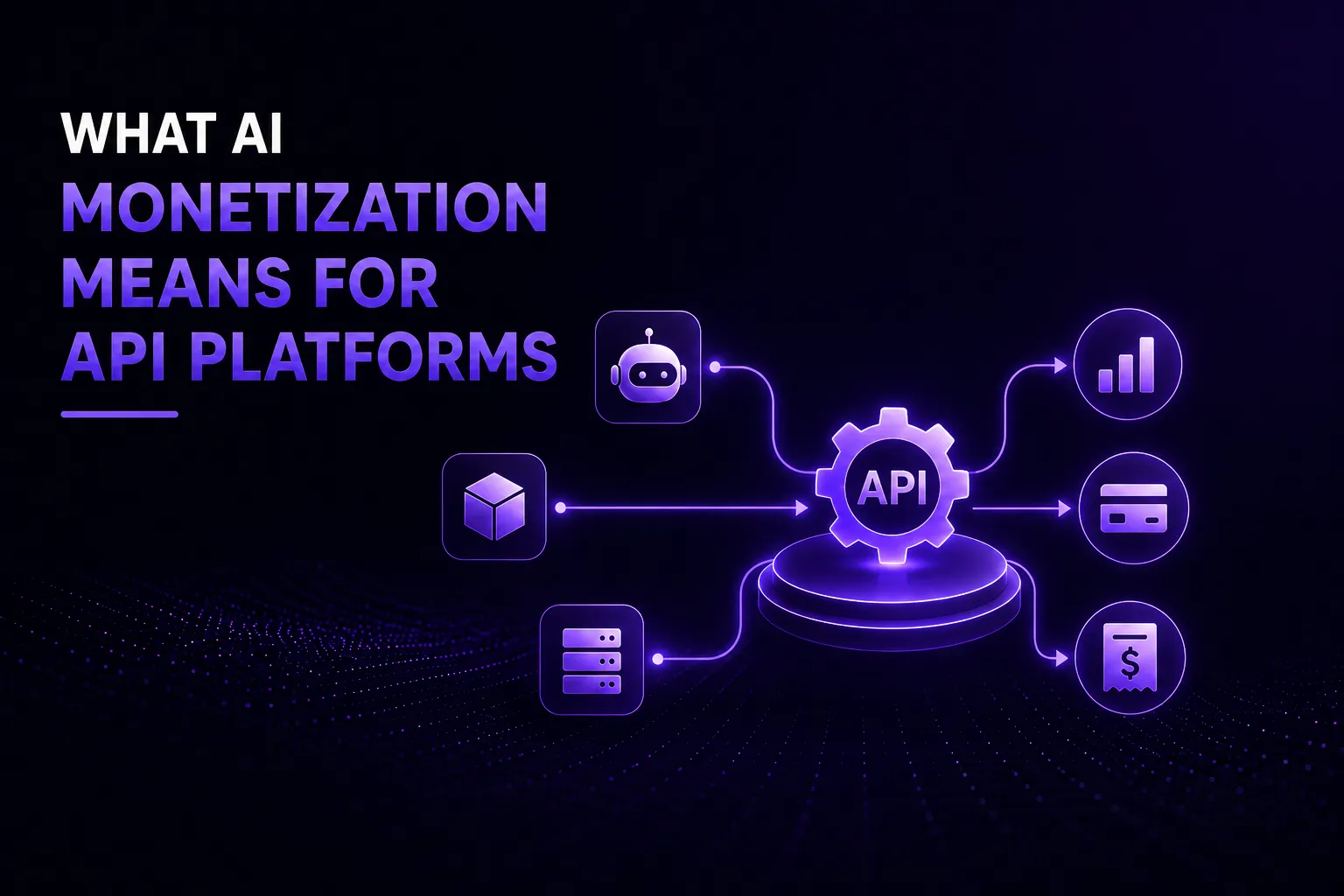
An API platform exposes software functionality or data through a programmatic interface so other systems can call it. It handles the gateway, authentication, rate limiting, metering, and billing that let a provider offer controlled access to a capability and charge for it. Unlike most of the infrastructure reshaped by AI, the API platform did not have to invent usage-based access. It has always sold consumption. A call is made, a call is counted, a bill follows.
That is why API platforms enter the AI era less disrupted than payment processors or content delivery networks. The core primitive, charging for programmatic access, is exactly what machine commerce needs. But the assumptions layered on top of that primitive were calibrated for human-managed integrations, and those assumptions are where agent consumption applies pressure. A human developer provisions a key, builds an integration, monitors usage, and adjusts when costs climb. An autonomous agent does none of that on a human timescale. It discovers, calls, and consumes continuously, and it does so at a volume where a single AI agent can produce more API calls in an hour than a human developer generates in a month.
The structural change is not that API platforms need to start metering. It is that the shape of what they meter, who they meter it for, and how they price it all shift when the caller is a machine acting on its own. The head start is real, but it is not the same as being ready.
The pricing tiers were drawn for humans, not agents
Most API pricing is tiered: a free or low tier for light use, higher tiers for heavier use, enterprise pricing above that. The model works when consumption is predictable and a human is managing it, because the customer can pick a tier that fits their integration and adjust deliberately when they outgrow it. Agent traffic breaks that predictability, because agents generate consumption that is bursty, variable, and decoupled from any human watching the meter.
The response across major API providers has been a wave of restructuring. Within weeks of each other in early 2026, several large platforms overhauled how they charge, replacing legacy tiers with usage-based systems explicitly designed for a world where agents, not just developers, consume at scale. X moved to a pay-as-you-go model, and its pricing history illustrates a recurring failure mode: a 25x jump between the Basic and Pro tiers with nothing in between, which leaves agent workloads either badly underserved or badly overcharged with no tier that fits. Amazon restructured its seller API around tiered monthly call volumes with metered overage. The common direction is toward hybrid models that pair a baseline with usage-based charges above it, because fixed tiers break down precisely when marginal consumption is variable and machine-driven.
The deeper issue is that per-call pricing treats every call as equivalent. A call returning a cached, low-value response and a call returning proprietary, high-value data cost the provider very differently and are worth very differently to the agent, yet a flat per-call rate prices them the same. As agents begin selecting services on price, this imperfection stops being a rounding error. It becomes an arbitrage an agent will exploit, routing high-value queries to underpriced endpoints and abandoning services whose flat rate no longer reflects what the call is worth. Pricing that does not track the value of what is returned will be gamed by systems optimising for cost.
API keys were built to identify a company, not an autonomous agent
Identity is the assumption agent consumption strains hardest. The API key was designed to identify a developer or an application: a stable, human-provisioned credential tied to an account, a billing relationship, and a set of permissions someone agreed to. It works because a person set it up and a person is accountable for it.
Autonomous agents do not fit that model cleanly. An agent may need to call a service it was not pre-provisioned for, discovered mid-task, with no account and no key. Requiring a human to register and configure a credential for every service an agent might touch reintroduces exactly the friction agent autonomy is meant to remove. This is why a parallel access model is emerging in which agents pay per call without a key at all, using inline payment to replace API keys and subscriptions so an agent can hit an endpoint, settle for that single request, and receive the data without any pre-existing relationship. The key-based model does not disappear, but it stops being the only way an agent reaches an API, and platforms that assume a provisioned key for every caller will be invisible to agents operating without one.
The accountability question underneath identity also changes. When a key identifies a company, the company is responsible for what the key does. When an agent acts on behalf of a user or organisation, the platform needs to know who authorised the action and within what limits, which is a harder question than checking a key against an account. Resolving it requires connecting identity to permissions at the moment of the call, the same problem we examined in the context of AI access control, now arriving at the API gateway rather than the content edge.
MCP is becoming the new API surface, and it inherits the metering problem
The most consequential shift in how agents consume APIs is that they increasingly do not call raw REST endpoints directly. They call tools exposed through the Model Context Protocol, which has become the default way agents invoke external capabilities. MCP is, in effect, a new API surface layered on top of the existing ones, and it changes what a provider is exposing and charging for.
This creates both an opportunity and a trap. Thousands of MCP servers shipped in the past year, and almost all of them are free, which means almost none of them are a business. The instructive part is where the difficulty actually lies. Once a provider decides to charge, the payment rail turns out to be the easy part, and the hard part becomes the meter, the deduplication, the per-tool rates, and turning thousands of sub-cent calls into one clean invoice. The economics are unforgiving at the low end: a tool call priced at a cent, invoked fifty times a day, generates about fifteen dollars a month while potentially costing more than that to meter accurately. Metering that survives real agent traffic is the product. The payment is a detail.
This reframes what an API platform's core competence is worth in the AI era. The gateway, the rate limiter, and the billing engine were supporting infrastructure around the actual product. In an agent-consumed world, accurate metering and clean aggregation of high-frequency, low-value calls are the product, because they are the hard, valuable thing that determines whether machine consumption can be charged for at all. Platforms that treat metering as solved infrastructure will discover it is the exact thing agent traffic stresses to breaking.
The friction is concentrating around access to proprietary data
The sharpest version of this shift is playing out in enterprise software, where the API is the gate in front of valuable business data. As agents began extracting that data at scale, the platforms holding it moved to meter the access. SAP began routing third-party AI agents and bulk extraction through a governed gateway, and ServiceNow, Salesforce, and Snowflake have introduced their own metering of agent access to the data on their platforms. The cost of enterprise AI is coming to include not just the model, but the price of reaching the data that powers it.
This exposes the cross-stakeholder friction directly. The platform holding the data wants to charge agents for access to it, because that access has clear commercial value and was previously extracted for free. The AI companies building agents want dependable, affordable access to that data without a bespoke commercial negotiation per platform. Enterprise customers deploying agents want cost predictability, and they are not getting it: enterprise AI spend has been climbing sharply while a large majority of IT leaders report unexpected charges, with pilots understating production cost by 500 to 1,000 percent. Regulators, meanwhile, are beginning to scrutinise whether a single platform metering access to essential data becomes a gatekeeper with pricing power over the whole market.
These interests do not reconcile through each platform building its own tollbooth, because that produces a fragmented landscape where every provider meters differently, prices opaquely, and forces agents into bespoke integrations. What the friction points toward is shared infrastructure for expressing access terms, metering consumption, and settling it in a way that works across providers rather than trapping value inside each one. This is the same conclusion that usage-based monetization reaches from the pricing side, arriving here from the access side.
Metering is the moat, and it has to connect to settlement
For an API platform, the path through the AI transition runs through the capability it already has and now has to sharpen. The platforms that price by consumption in a way that reflects value, identify agents without depending on a human-provisioned key, and meter high-frequency machine calls accurately will convert agent traffic into their strongest revenue line. The primitive is there. What is missing, for most, is the connection between metering and settlement that machine consumption requires.
Accurate metering answers what was consumed. It does not, on its own, express what that consumption is permitted to cost, or move payment for it without a billing cycle and a human-managed account behind the caller. Closing that gap is what turns a metered API into one an agent can actually transact with: terms the calling system can read before it commits, measurement of exactly what it used, and settlement that aggregates many small calls into something clean rather than drowning the provider in sub-cent transactions. This is the programmatic licensing problem restated for the API layer, where the thing being licensed is a call rather than a piece of content.
Supertab Connect provides that connective layer for providers exposing content, data, or functionality to machine consumers. It identifies the consuming agent, meters what is actually used, applies the provider's terms, and aggregates high-frequency events into settleable units on the rails the provider prefers. For an API platform, infrastructure of this kind extends the metering it already does into a full commercial relationship with agents, rather than leaving it with an accurate count of consumption it cannot cleanly charge for.
The Head Start Only Helps the Platforms That Extend It
API platforms begin the AI transition holding the primitive everyone else is scrambling to build. They already sell metered access, which is the exact shape machine commerce takes. That advantage is real, and it is why the API layer is where usage-based monetization of AI consumption will feel most natural first.
The advantage is not self-executing. Agent consumption breaks the human assumptions built around the primitive: tiers drawn for stable integrations, keys that identify companies rather than agents, per-call prices blind to the value of what they return, and metering that was never stressed by machine-frequency traffic. The platforms that rebuild those assumptions around how agents actually consume, and connect their metering to terms and settlement that operate without a human in the loop, will own the layer where the AI economy pays for the capabilities it runs on. The ones that rest on the head start will find that agents, which optimise relentlessly for cost and access, are the least sentimental customers the API economy has ever had. They will not stay for a pricing model that no longer fits them. They will route around it.


