
What AI Means for Publishers Experimenting with Micropayments
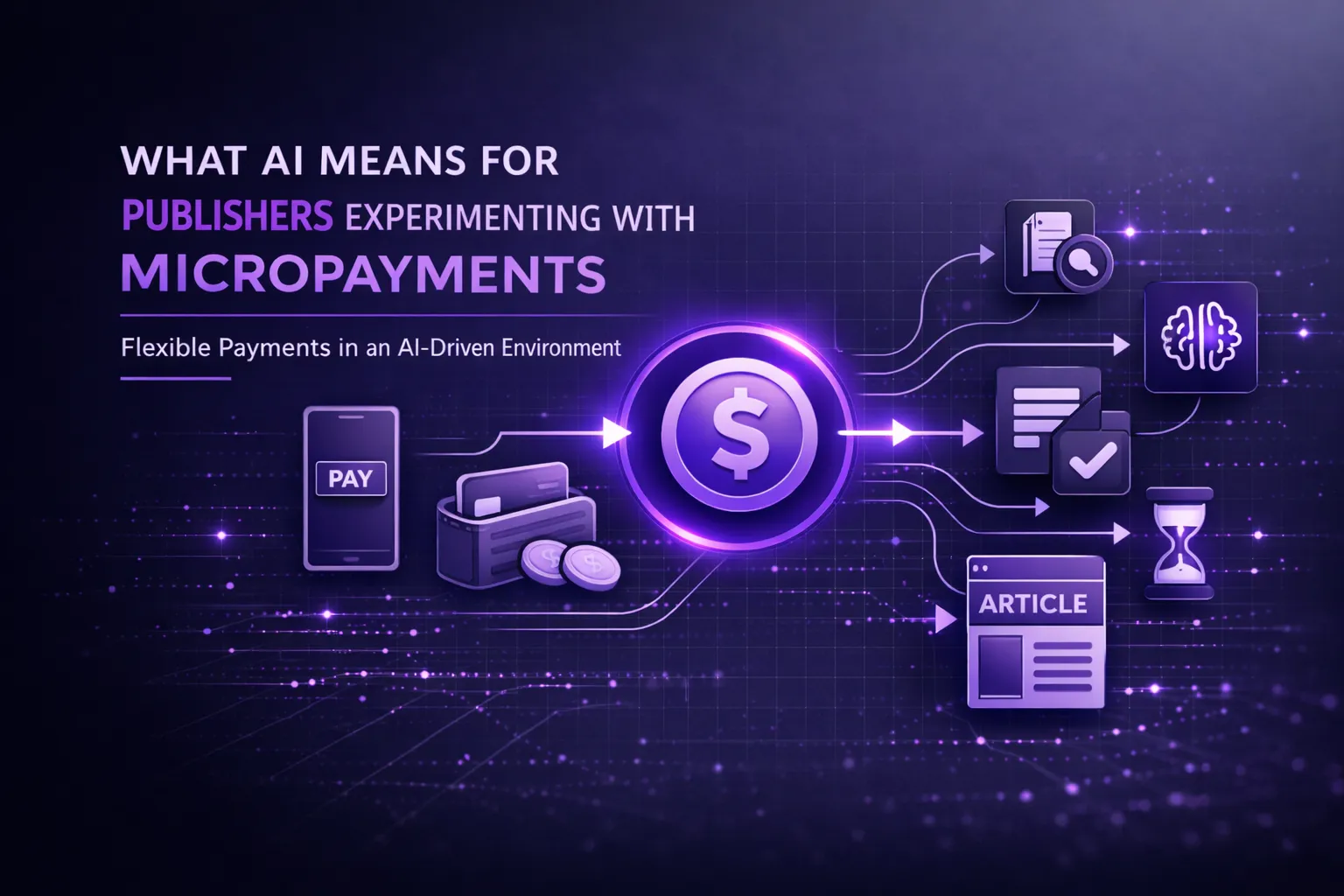
Publishers experimenting with micropayments sit in a specific part of the revenue market. They are trying to capture value from occasional readers, search visitors, social visitors, and topic-specific audiences who will not commit to a monthly plan but may pay for immediate access if the offer is simple enough. That includes national and local publishers, specialist titles, and digital outlets that already know subscriptions leave money on the table. Recent audience data shows that the proportion paying for online news remains stable at 18% across 20 richer countries, which leaves a large pool of readers outside the subscription base. That is the commercial gap micropayments are meant to address.
AI makes that gap harder to capture. A casual reader who once landed on an article and decided whether it was worth a small payment may now get enough of the answer inside search or chat. Search products are increasingly built so that these experiences are designed to help users get to the gist of a topic quickly and then explore further through links. For publishers testing micropayments, that changes the unit of opportunity. The issue is no longer only whether a reader will pay a small amount. It is whether the reader reaches the publisher at all, and whether the payment flow is light enough to convert occasional intent before it disappears.
Why micropayments appeal to publishers in the first place
Micropayments appeal to publishers because subscriptions solve only one part of the market. They work best for habitual readers with strong brand loyalty, repeated use, and a clear willingness to pay. They do much less for the visitor who wants one article, one afternoon of access, one archive item, one sports recap, one piece of market analysis, or one local update during a moment of need. Industry discussion around the model has long pointed out that casual payments are really about flexible access, not tiny theoretical price points. That distinction matters because the business case is really about matching price to intent.
Publishers keep returning to the model because the economic logic is still sound. A rigid subscription paywall can force a binary outcome: subscribe or bounce. Flexible pricing gives publishers another chance to monetize value that would otherwise disappear. The same logic now appears inside larger platform tools as well, with more ways to monetize content beyond traditional ads and more user choice around how access is granted.
The challenge of friction
Micropayment experiments usually fail because the payment experience is clumsy relative to the value of the content. If a reader must register, verify, enter card details, approve a tiny transaction, and repeat the process the next time they return, the friction outweighs the price. At that point the checkout flow becomes the real product, and it is a weak one.
That is exactly the problem we are built to solve. Supertab lets publishers combine micropayments, time-based access, subscriptions, and usage-based access in the same system. We make micropayments viable through aggregation, so small purchases can accumulate in a running tab instead of forcing full payment processing on every tiny event. The important point for publishers is the mechanism. Micropayments work better when repeated purchase friction falls and value comes before settlement.
AI changes the shape of the casual reader funnel
Micropayments are built for casual intent. That is why AI matters so much here. Casual readers are the first audience segment to get intercepted by answer engines. A loyal subscriber may still come directly, open the app, or rely on a newsletter. The occasional reader is much more likely to ask a question in search, receive a summary, and stop there.
That directly affects the micropayment funnel. If the user never lands, the publisher never gets the chance to present a one-off offer. If the user lands less often, the publisher gets fewer opportunities to test article pricing, day passes, or time-based access. User behavior research now shows that Google users are less likely to click on links when an AI summary appears. For publishers relying on casual payments, that decline is more than a traffic issue. It narrows the pool of users most likely to buy occasional access.
Micropayments also need to be understood as part of a wider revenue architecture. They are one way of pricing access in a market where attention is fragmented, subscriptions are capped, and AI compresses the path between question and answer. Broader media trend data points in the same direction, with consumer engagement and spending spread across many services and subscriptions.
Why publishers are testing flexible access instead of choosing one model
The most realistic micropayment strategy is usually hybrid. Publishers are not choosing between subscriptions and one-off payments as if only one can exist. They are trying to price different forms of value for different users.
That is where infrastructure matters. We let publishers combine micropayments, time-based access, subscriptions, and usage-based access in the same system. Google’s Offerwall product reflects that broader shift too, because publishers can add their own choices, including newsletter sign-ups and other exchange-based options. In practice, the market is moving toward layered monetization rather than a single hard paywall for everyone.
That is useful for publishers experimenting with micropayments because the model no longer has to carry the whole business on its own. Micropayments can serve the occasional visitor, time passes can serve the event-driven visitor, subscriptions can serve the habitual reader, and advertising can still monetize some free access. The strategic question is how those layers fit together without confusing the user or undermining higher-value products.
What AI does to the economics of pay-per-article
Pay-per-article models always depended on a simple premise: the article page is where value becomes real. AI weakens that premise because the first value event may now happen off-site.
If the summary answers enough of the question, the article itself becomes less monetizable as a standalone purchase. That does not mean paid access disappears. The formats most likely to hold up are the ones where the publisher offers something the summary does not fully replace. That may be deeper analysis, specialist reporting, archives, local specificity, live coverage, ad-free utility, or a clean time-based access offer that feels easier than a permanent commitment.
This is one reason time-based access is increasingly relevant. Publishers using this model can sell access by the hour, day, or week rather than forcing a permanent commitment. A reader who will never subscribe may still pay for a weekend of coverage, a day pass during a breaking event, or access to a specific premium package. That is closer to how many users think. They want immediate utility.
The operational lesson: micropayments are an infrastructure problem
Publishers often treat micropayments as a pricing problem. Price matters, yet infrastructure matters more. The key questions are operational.
Can the publisher launch without deep engineering work? Can the payment layer sit alongside subscriptions instead of replacing them? Can different products be bundled under one running balance? Can the publisher test one article, one day pass, one premium feature, or one event-based offer without rebuilding the site? Can it run inside Google Ad Manager if the publisher already uses that stack?
We address this problem with no-code integration with Google Ad Manager Offerwall, low-code paywall options, and support for single items, time-based access, subscriptions, and hybrid models. Publishers experimenting with micropayments are really choosing infrastructure first and price second. Without a system that reduces operational drag, the experiment dies before the pricing learns anything useful.
Micropayments also create a bridge between human and machine monetization
Micropayments train publishers to think in units smaller than subscriptions. That mindset matters in the AI era because machine access will not always map neatly to monthly plans either. If a publisher already knows how to price limited usage, single events, temporary access, or per-feature value, it is closer to the logic needed for AI-era monetization.
That is where Supertab Connect becomes relevant. We built it as content licensing infrastructure for the AI era, helping copyright owners define and manage how AI systems access content. For publishers already experimenting with human micropayments, the connection is straightforward. A business that learns to meter occasional human access is often better prepared to meter machine access as well. Human casual payments and machine licensing are different markets, yet they rely on a similar discipline around packaging, rights, and settlement.
Why audience choice matters more than ever
One of the clearest recent framings of this shift is around choice. The Google Offerwall gives publishers more options to monetize and audiences more control over how they access content. That framing fits micropayments especially well. The model works best when it does not force every user into the same path.
Some users will still subscribe. Some will choose free access supported by ads. Some will exchange attention through rewarded ads or surveys. Some will pay a small amount because they want instant access without a long-term commitment. Publishers experimenting with micropayments are really testing a more flexible contract with the audience. They are asking whether access can be priced in a way that matches real behavior instead of forcing users into a single revenue model.
This matters because consumer budgets are under pressure. Longitudinal media data shows rising price sensitivity across subscriptions and entertainment spending. In that environment, flexible payments are a response to how buyers increasingly want to consume digital products.
Forward implications for publishers experimenting with micropayments
Publishers experimenting with micropayments are testing more than a price point. They are testing whether access can be sold in smaller, smarter units that fit casual intent, search-driven behavior, and AI-mediated discovery. The long-term opportunity is a more adaptable monetization stack where subscriptions, time passes, single-item unlocks, advertising, and machine licensing all have a place.
That is why this category matters. Micropayments are often dismissed as a niche experiment or a revived old idea. In practice, they are becoming part of a broader shift toward usage-based monetization. Publishers that get this right may not abandon subscriptions. They will stop expecting subscriptions to do all the work.
The publishers most likely to benefit are the ones that treat micropayments as a disciplined product and infrastructure choice. They will reduce checkout friction, match price to intent, connect casual payments to stronger first-party relationships, and build systems that can later support machine-readable licensing too. In that sense, micropayments are less about small charges than they are about learning how to monetize value one access event at a time.


