
What AI Means for Ad-Dependent Publishers: Yield, Volume, and the Loss of the Click
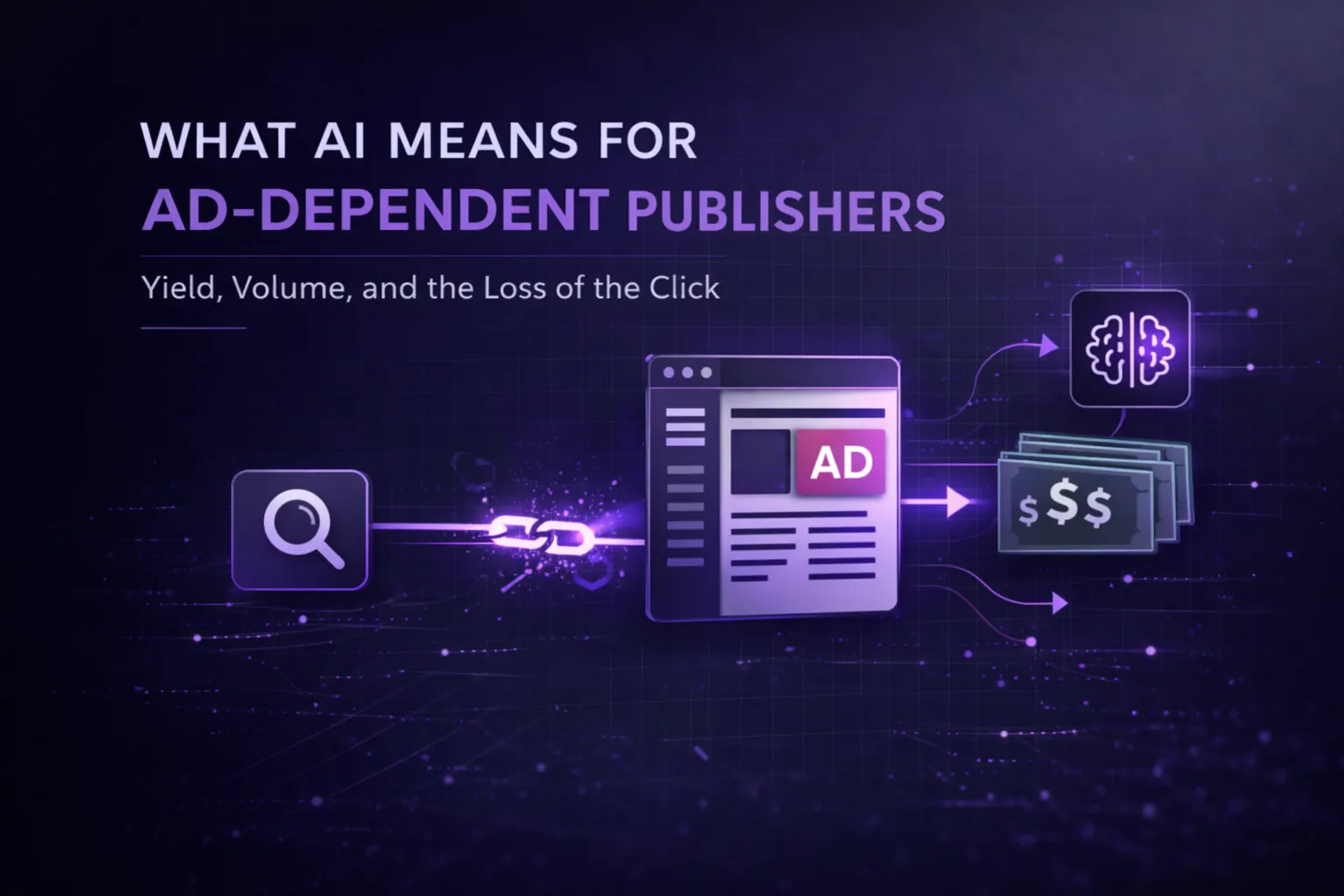
Ad-dependent publishers are outlets whose business still leans primarily on advertising revenue rather than subscriptions, licensing, or premium information products. That includes many digital news sites, entertainment publishers, lifestyle brands, sports outlets, and content businesses built around search, social distribution, and programmatic monetization. Their model depends on a simple sequence: attract traffic, create sessions, serve ads, and turn audience volume into revenue.
Generative AI weakens that sequence because more discovery now ends inside search and chat interfaces rather than on publisher-owned pages. Google says these experiences are designed to help users get to the gist of a topic quickly and explore content through linked results. For ad-dependent publishers, the tension is immediate. Even when links remain present, fewer visits can mean fewer ad impressions, fewer refresh opportunities, and less time spent on site.
Why ad-dependent publishers are exposed first
Ad-dependent publishing is more directly exposed to AI-mediated discovery than other publisher models because the revenue signal is immediate. A subscription-heavy publisher may feel AI pressure through weaker conversion or lower retention over time. An ad-dependent publisher often feels it in the next traffic report.
That is because the commercial unit is usually the pageview or session. Fewer visits mean fewer impressions. Fewer impressions mean less inventory to sell directly or through programmatic channels. When the user’s question is answered before a click happens, the publisher loses the opportunity to monetize that moment at all.
This is particularly important for publishers that built large parts of their business around search-driven informational demand. Service journalism, celebrity coverage, commerce content, explainers, evergreen advice, and fast-turn aggregation have all historically benefited from high-volume referral flows. AI changes that because it can summarize or synthesize enough of the answer to satisfy intent without sending the user onward. Google explicitly says its AI features help users understand topics faster inside Search, which is exactly the sort of compression that puts attention-based publisher economics under pressure.
The ad market can grow while ad-dependent publishers get squeezed
This is where the issue gets confusing. Digital advertising overall is still large and growing. The IAB/PwC Internet Advertising Revenue Report says U.S. digital advertising reached roughly $259 billion in 2024, up about 15% year over year. That sounds healthy. But a growing digital ad market does not guarantee that ad-dependent publishers will capture the growth.
Publisher economics depend on where attention occurs and who controls the monetizable surface. If discovery shifts into interfaces owned by search platforms, AI assistants, or chat products, then more value can be captured upstream from the publisher page. The market may still reward digital advertising broadly while individual publishers lose the inventory that once made their own model work.
For ad-dependent publishers, that is the real problem. AI does not need to destroy the advertising market. It only needs to remove enough publisher-side impressions to make the model weaker at the publication level.
Why the loss is bigger than a single missing pageview
A lost click does not only remove one impression. It often removes a chain of monetizable events.
Many ad-dependent publishers do not earn from a single page. They earn from the second page, the recommendation module, the gallery continuation, the video autoplay, the recirculation widget, the related story unit, the newsletter sign-up that brings the user back tomorrow, and the user data that improves future targeting and packaging. When AI answers a question upstream, it interrupts that entire chain.
That is why ad-dependent publishers are vulnerable even when AI-driven discovery still includes links. The problem is not binary visibility. It is compression. The user journey becomes shorter, and a shorter journey usually means fewer opportunities to monetize. Pew found that Google users are less likely to click on links when an AI summary appears, which is exactly the kind of behavior shift that weakens pageview-driven monetization.
This matters even more for publishers with thin margins and high dependence on open-web distribution. If a business has not built a meaningful subscription base, does not own premium data products, and has limited direct-sold advertising leverage, then traffic compression has an immediate revenue effect because there are fewer alternative sources of yield to offset it. Chartbeat data reported by Axios shows that small publishers have seen the steepest declines in search referral traffic, with chatbot referrals nowhere near large enough to make up the difference.
Programmatic logic weakens when fewer monetizable surfaces exist
Programmatic advertising depends on scale, fill, and yield. AI affects all three.
Scale suffers when fewer users arrive. Fill can become harder when session depth falls and inventory patterns become less predictable. Yield can weaken because the highest-volume pages are often the ones most exposed to answer-style summarization, especially for informational queries that no longer require a visit.
This creates a commercial mismatch. The publisher still bears the cost of reporting, editing, hosting, compliance, distribution, and sales operations. But the monetizable path from content to revenue becomes narrower.
It also makes forecasting harder. If large parts of discovery move into AI-mediated environments, ad-dependent publishers have to rethink how they model inventory value. Historical assumptions based on search referrals, page depth, and recirculation rates become less stable. Reuters Institute’s annual trends report shows media leaders are increasingly focused on distribution volatility, platform dependence, and AI disruption.
Advertisers buy outcomes, not nostalgia for the publisher homepage
Advertisers do not fund publishers out of loyalty. They buy reach, audience quality, context, brand safety, and measurable outcomes.
That means ad-dependent publishers cannot rely on the argument that their content still influences the user somewhere upstream in the journey. Influence alone does not restore revenue. If the advertiser cannot see the impression, attribute the action, or measure the audience behavior on publisher-owned surfaces, budgets will flow toward the channels that can.
This is one reason AI creates pressure beyond traffic loss. It shifts the location of measurable engagement. Even if publisher content is still shaping user decisions, the monetizable proof point may move somewhere else.
For publishers that already struggle with commodity CPMs, that is dangerous. AI can turn their reporting into an upstream input while leaving the economic capture to the interface that resolved the query.
Why ad-dependent publishers cannot solve this with subscriptions alone
Some ad-dependent publishers will diversify into subscriptions, memberships, or premium products. Many should. But that does not mean a subscription pivot is a practical answer for every business.
A large portion of ad-dependent publishing is built around broad audiences, casual intent, or content categories where willingness to pay is limited. These publishers are optimized for reach, frequency, and advertiser demand, not necessarily for premium access or high reader revenue conversion. Moving such businesses into a subscription model is often harder than it sounds because the product, audience expectations, and acquisition economics were not built for it.
That means many ad-dependent publishers still need advertising to work. The challenge is that advertising can no longer depend so heavily on a discovery model where search sends the user to the publisher page as the default next step. Reuters Institute’s 2025 digital news data shows news consumption continues to fragment across platforms and interfaces, which makes that older discovery model less dependable even before AI is factored in.
The structural tension: visibility versus extraction
Ad-dependent publishers face a narrow operating space. They need visibility because traffic is still the core fuel of the business. Blocking too aggressively can cut off discovery and worsen the very revenue pressure they are trying to solve.
At the same time, fully open machine access increases the risk of uncompensated extraction. If AI systems can crawl, summarize, and answer against publisher content at scale, then the publisher may preserve relevance while losing monetizable visits.
This is why the issue is not simply whether to allow or block AI use. The harder question is how a publisher stays legible to discovery systems while retaining a clear economic claim over machine consumption. Cloudflare argues publishers should be able to stop scraping and require permission, which shows how quickly rights control is moving from theory to infrastructure.
That requires more than SEO. It requires technical and commercial controls that can separate visibility from free extraction.
What ad-dependent publishers need from infrastructure
The first requirement is measurement. Publishers need clearer visibility into how AI-mediated discovery affects traffic, click-through, session quality, and downstream monetization. Google says appearances in AI features are included in overall Search Console reporting, which means publishers can at least begin to analyze these changes inside existing measurement workflows. But that is only a starting point. Publishers also need a clearer view of which systems are accessing their content directly, not just which users arrive after a search result.
The second requirement is machine-readable rights control. Ad-dependent publishers need ways to define what automated systems can do with their content across crawling, previewing, grounding, and retrieval. Google explains that publishers can manage some aspects of how content appears in Search through controls such as nosnippet, max-snippet, and noindex, and points to controls around AI-related usage. That does not solve the whole market, but it shows why machine-level controls matter.
The third requirement is programmatic settlement for machine usage. If machine systems use publisher content in ways that reduce on-site monetization, publishers need revenue mechanisms that do not depend entirely on recovered pageviews. That does not mean every interaction should be licensed individually tomorrow. It means the market needs infrastructure capable of pricing and settling machine consumption when usage is measurable and permitted. Cloudflare’s new model and publisher support for permission-based crawling point in the same direction: the market is starting to treat machine access as something that can be governed and priced.
Without those capabilities, ad-dependent publishers remain trapped in a model where all value still has to route through the click, even as the click becomes less central.
How ad-dependent publishers may need to rebuild yield
The most resilient ad-dependent publishers will likely push harder into surfaces that AI summarization cannot replace as easily.
That includes stronger direct audience channels such as newsletters, apps, alerts, video franchises, podcasts, and community products that create repeat visitation outside generic search. It also includes ad products tied to context and habit rather than pure page volume, such as sponsorships around recurring formats, premium vertical packages, and branded utility.
This does not remove the pressure on open-web inventory. But it can reduce dependence on the most substitution-prone traffic.
Publishers may also need to treat parts of their archive and current output as licensable machine-facing assets rather than assuming every dollar must come from display advertising. For ad-dependent businesses, that is a meaningful shift in revenue logic. The old assumption was that value became real only when a person visited the page. The emerging reality is that value may also be created when a machine retrieves, summarizes, or grounds against the content. If that usage remains invisible and unpaid, the publisher is subsidizing the system that is reducing its traffic. Tow Center coverage summarized by Nieman Lab notes that AI chatbots drive referral traffic at rates far below traditional search, which reinforces why the click alone is no longer enough as the sole monetization path.
Cross-stakeholder friction will shape the outcome
Ad-dependent publishers do not control this transition alone. Search platforms want to improve the user experience and keep discovery efficient. AI companies want fresh, reliable content that strengthens answers. Advertisers want measurable outcomes and stable environments. Publishers want traffic, compensation, and control. Regulators are increasingly focused on transparency, copyright, and the market effects of AI-mediated consumption.
These tensions are already visible in industry research. Reuters Institute’s trends work shows how central platform dependency, traffic risk, and AI disruption have become for news organizations assessing the year ahead. Columbia Journalism School’s Tow Center also notes that AI search tools are cutting off traffic flow to original sources, even as user adoption grows.
That means the future of ad-dependent publishing will not be decided by editorial quality alone, or by SEO alone, or by ad sales execution alone. It will also depend on whether publishers can influence the commercial and technical rules around machine access before those rules harden around platform convenience.
Forward implications for ad-dependent publishers
Ad-dependent publishers are the clearest test case for what AI does to attention-based media economics. Their model has always depended on monetizing visits at scale. When AI reduces the number of visits, it reduces the number of sellable moments.
That does not mean the category disappears. It means the business has to become less dependent on the assumption that discovery naturally produces monetizable pageflow.
The next phase for ad-dependent publishers is likely to involve three moves at once: defend direct traffic where it still matters, build stronger repeat-use surfaces that are less exposed to answer substitution, and create ways to measure and monetize machine usage when publisher content is consumed off-site.
The publishers that adapt fastest will be the ones that stop treating the lost click as the only revenue problem. The bigger problem is that machine-mediated discovery changes where economic value is captured. Once that is clear, the commercial task becomes clearer too. Publishers need revenue mechanisms that fit the new path from content to consumption, even when that path no longer runs through the homepage.


