
Enforcement vs. Monetization: The Infrastructure Divide
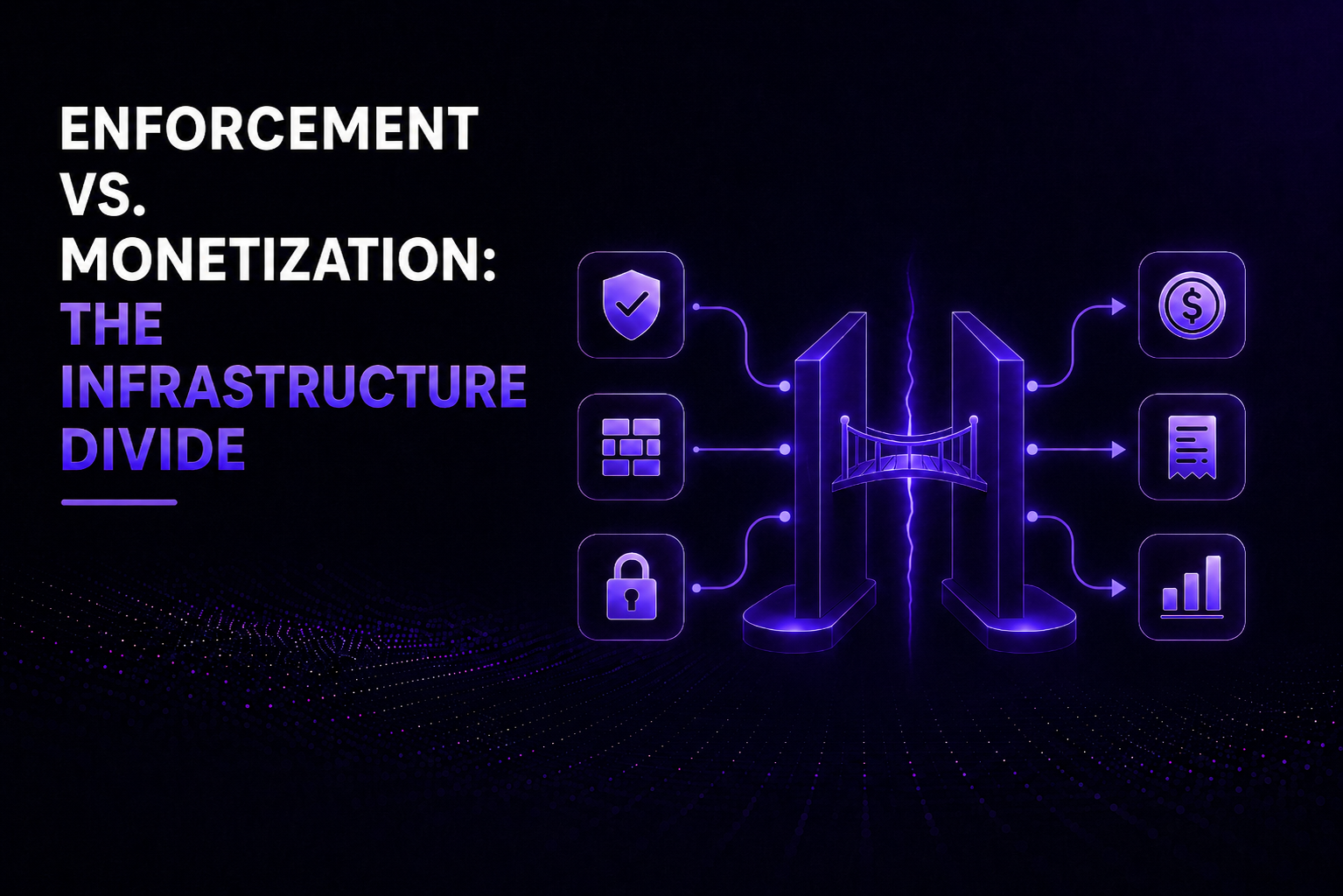
Across the infrastructure that carries AI traffic, a common pattern has emerged. The content delivery network can block a crawler at the edge. The web application firewall can filter an agent by rule. The identity provider can verify who an actor is. The API platform can gate access with a key. Each of these is an act of enforcement, a yes-or-no decision applied to a machine request at the moment it arrives.
Enforcement is necessary, and the industry has become good at it. The problem is that enforcement is only half of what the AI economy requires, and it is the half that does not generate income. A blocked crawler stops taking content, but the content owner earns nothing from the block. A verified agent is confirmed to be who it claims, but verification does not bill it. A gated API keeps out unauthorised callers, but the gate is not a cash register. The capability to say no, or to say yes, is not the same as the capability to say yes, for this price, settled automatically.
This is the infrastructure divide. On one side sits enforcement: identification, filtering, gating, verification, all the mechanisms that control whether a request proceeds. On the other sits monetization: the terms, metering, and settlement that turn a permitted request into a paid transaction. Most infrastructure providers today live entirely on the enforcement side, and the reason matters, because the AI economy will reward the providers that cross the divide and leave behind the ones that treat control as the whole job.
Enforcement was the first response because it was the available one
When AI crawling first overwhelmed the web, the tools already in place were defensive. Content owners reached for what they had, which was the ability to block. The result was a binary choice that everyone in the ecosystem now recognises as inadequate: allow everything and give content away, or block everything and disappear from the channels where AI increasingly mediates discovery. As Stack Overflow described its own reckoning, the traditional open-or-blocked model was simply not built for this moment.
The binary is a trap because both options forfeit value. Blocking protects content but forecloses revenue and can cost real audience, since research has found publishers who blocked AI crawlers lost meaningful human traffic alongside the bots. Allowing everything preserves reach but captures nothing, in an environment where the old exchange of crawling for referral traffic has collapsed. Cloudflare's own figures put the crawl-to-referral ratio at 11,000 pages crawled for every referral for one major AI company, which is another way of saying the free exchange stopped being an exchange. Enforcement gave content owners a switch. It did not give them a business model.
What makes enforcement insufficient is structural, not a matter of better rules. The mechanisms of control were designed to answer a security question, is this request permitted, and the AI economy is asking a commercial one, what is this access worth and how does the provider get paid for it. A tool built to answer the first question does not answer the second simply by being more precise. A more accurate block is still a block. This is the recurring conclusion across every infrastructure layer, from the content delivery network deciding whether to serve a crawler to the API platform deciding whether to honour a call.
The market is now trying to cross the divide
The most important shift of the past year is that the industry has recognised the divide and begun building across it. The framing has moved from block-or-allow to what Stack Overflow calls a yes, if framework: programmatic, usage-based access granted on the condition of payment. The dormant HTTP 402 status code, "Payment Required," has become the technical hinge of this shift, turning a request that would once have been blocked into one that can be priced.
The direction of travel is visible in how the enforcement players themselves are evolving. Cloudflare, having started with a one-click block, moved to Pay Per Crawl, and is now extending toward a Pay Per Use model where publishers are paid when their content actually contributes to an AI answer rather than merely being fetched. AWS has built AI-traffic monetization into its firewall, letting content owners turn edge detection into a billable event rather than a blanket block. The enforcement layer is reaching for the monetization layer, because control alone has become a commodity and the value has moved to what happens after the yes.
This is the transition from a security posture to a commercial one, and it changes what the underlying capabilities are worth. Identification stops being only a way to keep bad traffic out and becomes the precondition for knowing who to charge. Metering stops being an operational metric and becomes the basis for pricing. The same request the firewall or CDN was configured to permit or deny becomes the front end of a transaction. Enforcement does not disappear in this model. It becomes the gate in front of a toll, rather than a wall with nothing behind it.
Crossing the divide requires three things enforcement does not supply
The reason so few providers have fully crossed the divide is that monetization requires capabilities enforcement never needed. Deciding whether a request proceeds is a single judgement. Turning that request into revenue takes three additional components working together, and each is a distinct piece of infrastructure.
The first is machine-readable terms. For a permitted request to be a priced one, the conditions of access have to be expressed in a form the requesting system can read and act on before it proceeds. This is the work of machine-readable licensing, and without it, access defaults to either free or blocked because there is no legible middle. The second is metering, an accurate record of exactly what was accessed and by whom, because there is no pricing without measurement and no settlement without attribution. The third is settlement that operates at machine speed and scale, aggregating vast numbers of small events into something payable rather than drowning in per-event transactions. Together these are the substance of programmatic licensing, and they are what an enforcement tool lacks.
The critical point is that these components have to connect to the enforcement layer, not replace it. A settlement system with no enforcement cannot compel payment, because there is nothing stopping a system that declines to pay. An enforcement system with no settlement cannot capture value, because it can only permit or deny. The two halves are complementary, and the infrastructure that matters is what joins them. This is the same conclusion reached from the pricing side by usage-based monetization: the mechanism to charge is only useful when it is wired to the mechanism that controls access.
The concentration risk in a divide only one company crosses
There is a real danger in how the divide is being crossed. When a single provider controls identification, permissions, measurement, and payment all at once, it does not just bridge the gap, it owns the bridge. Observers of Cloudflare's move have noted exactly this, warning that one intermediary could end up controlling the identification of agents, the permissions layer, the usage measurement, and the payment infrastructure simultaneously. Publishers gain leverage over AI companies while deepening their dependence on the intermediary that sits between them.
This is the cross-stakeholder friction that defines the current moment. Content owners want to be paid, but not at the cost of being captured by whoever operates the toll. AI companies want to pay for legitimate access, but not to negotiate a different scheme with every intermediary and every provider. Both sides benefit from crossing the divide, and both are wary of a crossing controlled by a single gatekeeper. The unresolved problem of attribution sharpens the concern, because an AI answer may draw on many sources, and someone has to decide how value is calculated, who audits it, and how disputes are settled.
The way through is interoperability rather than consolidation. If terms, metering, and settlement are built on open standards that any enforcement layer can read and any provider can implement, the divide gets crossed without a single company owning the crossing. This is why standards work matters as much as product, and why the monetization layer should be something a CDN, a firewall, or an API platform can connect to rather than something only one network provides. The alternative, a divide crossed by one bridge with a toll-keeper, trades the old binary for a new dependency.
Where Supertab sits in the divide
Supertab was built specifically for the monetization side of this divide and to connect to the enforcement side rather than compete with it. Supertab Connect supplies the three components enforcement lacks: it lets content and service owners publish machine-readable terms, meters what is actually consumed, and aggregates and settles that usage automatically, on the rails each party prefers. It is designed to work with the enforcement points that already exist, so the CDN that blocks, the firewall that filters, and the identity provider that verifies can all connect their yes-or-no decision to a priced, settled transaction.
That connection is the whole point. The enforcement layer answers whether access happens. The monetization layer answers on what terms and for what price. Infrastructure that joins the two, without forcing every provider onto a single company's rails, is what turns the AI economy's control points into economic ones. The goal is not to replace enforcement but to give it the other half it has been missing, so that saying yes to machine access finally means getting paid for it.
The Providers That Only Enforce Will Be Priced by the Ones That Settle
The infrastructure divide is the defining structural fact of AI monetization. On one side, a mature and increasingly commoditised set of tools for controlling machine access. On the other, the terms, metering, and settlement that turn controlled access into revenue. For most of the past year, providers lived entirely on the enforcement side because that was where the tools already were. That is changing, and the change is where the value is moving.
The providers that stay on the enforcement side will keep doing important work, and they will keep being seen as a cost: necessary, defensive, and disconnected from the revenue their control makes possible. The providers that cross to the monetization side, or connect to infrastructure that does, will occupy the layer where the AI economy actually settles its accounts. The decisive question is not who can block the most effectively or verify the most reliably. It is who can turn a permitted request into a paid one, because in an economy built on machine access at scale, the ability to enforce is table stakes and the ability to settle is the business.


