Large enterprise publishers are confronting a structural shift in digital economics. Generative AI systems now ingest, summarize, and retrieve publisher content at machine scale. This change affects traffic patterns, subscription growth, and advertising revenue.
For decades, enterprise publishing relied on pageviews and subscriber conversion. Today, AI systems such as Google’s Search Generative Experience and Microsoft’s AI-powered Bing intermediate access to news and analysis. Users increasingly receive direct answers instead of visiting original sources.
The central question is no longer whether AI will use publisher content. It is how publishers will monetize that usage. AI content licensing for publishers is becoming a strategic necessity rather than an optional defensive measure.
How Generative AI Impacts Enterprise Publishing Revenue
Generative AI impacts revenue through two mechanisms: traffic displacement and training data extraction.
Traffic Displacement
AI search interfaces reduce click-through rates by satisfying informational queries directly within AI responses. When fewer users visit publisher websites, advertising inventory declines and subscription funnels weaken.
Publishers such as The New York Times have emphasized digital subscriptions as a core growth strategy in investor communications. Reduced referral traffic directly affects that model.
AI Training Data Licensing Pressure
Large language models require vast corpora of text for training. The legal and economic debate over AI training data licensing has intensified, including high-profile cases such as the lawsuit reported by Reuters.
This raises a monetization issue: if publisher archives contribute to AI model performance, how is that value captured?
Enterprise publishing AI strategy must now include structured training data licensing and machine-readable rights management.
Why Advertising Alone Cannot Fund AI-Mediated Content Use
Traditional digital advertising depends on user journeys with multiple monetizable surfaces. Generative AI compresses that journey into a single interaction.
Google’s generative search documentation illustrates this shift toward direct answers. Advertising economics do not align with AI compute costs. Display CPMs generate marginal revenue per impression, while AI queries incur meaningful inference expenses. This structural mismatch limits the viability of advertising as the primary monetization mechanism for AI-driven content usage.
For large media companies, this reinforces the need for AI monetization models beyond advertising.
Subscription Fatigue and the Limits of Paywalls
Subscriptions remain viable for premium journalism. However, subscription fatigue is increasing across digital markets. Research on streaming churn and consumer fatigue is documented by Deloitte.
As users adopt multiple AI tools across research, productivity, and creative workflows, committing to separate subscriptions becomes inefficient. If AI systems summarize premium content without redirecting users, subscription conversion becomes harder.
This does not eliminate subscription models. It requires complementary AI licensing infrastructure that monetizes machine access without undermining subscriber value.
What Is AI Licensing Infrastructure for Publishers?
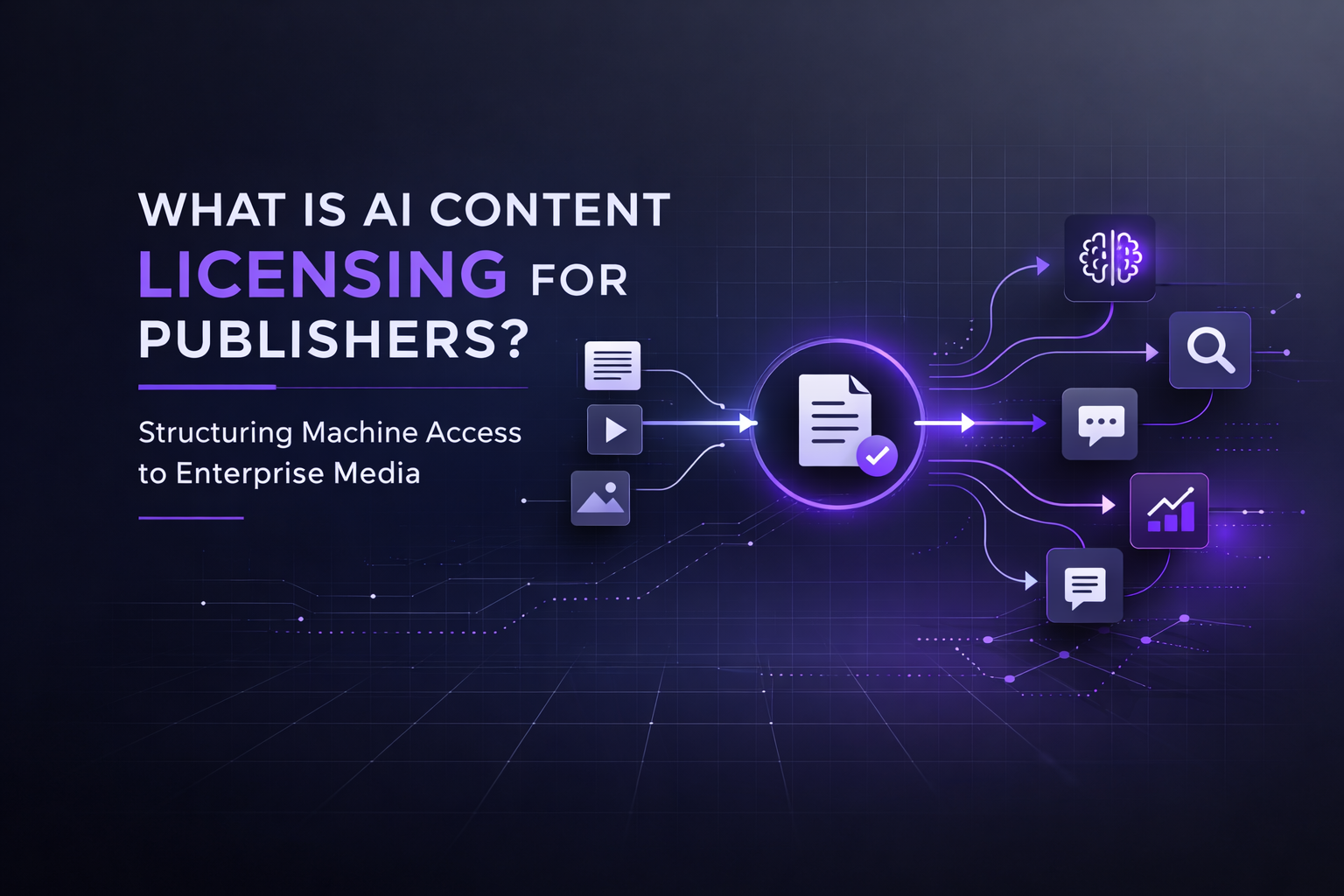
AI licensing infrastructure is not a single standard or product. It refers to the capabilities publishers need to control and monetize machine access to their content at scale. The issue is structural. AI systems crawl, train, retrieve, and generate continuously. Manual contracts and reactive enforcement cannot operate at this frequency. Infrastructure must handle it.
At a high level, enterprise publishers need three core capabilities.
First, machine-readable rights expression. AI systems must be able to interpret whether content is available for indexing, training, or inference retrieval. Emerging standards such as Really Simple Licensing illustrate how rights can be encoded in structured formats, but the broader requirement is clear signaling that machines can understand automatically.
Second, monitoring and transparency. Publishers need visibility into which AI systems are accessing their content and how it is being used. Without measurement, there is no pricing strategy and no enforceability.
Third, programmatic settlement. If AI systems access licensed content, compensation must flow automatically. Usage-based billing and machine-to-machine payment models are necessary to align incentives at AI scale.
Industry coordination efforts such as the RSL Collective support standard adoption, but governance alone does not create monetization. The economic layer emerges only when rights expression connects to automated settlement.
For enterprise publishers, this is not a compliance question. It is an economic design question. The publishers that implement scalable licensing infrastructure will convert AI usage into structured revenue. Those that do not will remain dependent on traffic models that AI increasingly bypasses.
Enterprise Publishing AI Strategy: Three Strategic Paths
Enterprise media companies currently face three strategic responses to generative AI:
1. Restrictive Blocking
Technical and legal barriers prevent AI scraping. This protects intellectual property but may reduce discoverability.
2. Bilateral AI Licensing Deals
Some publishers are negotiating direct agreements with AI companies. Media coverage of such deals has appeared in outlets such as The Guardian and Reuters. These agreements generate revenue but do not scale across emerging AI startups and enterprise AI deployments.
3. Standardized AI Monetization Frameworks
Adopting interoperable licensing standards enables ecosystem-wide participation. This approach positions publishers as infrastructure participants in the AI economy rather than passive content suppliers.
Long-term sustainability favors standardized, machine-readable AI monetization models.
Cross-Stakeholder Friction in AI Copyright Licensing
AI copyright licensing affects multiple stakeholders:
- Publishers seeking compensation
- AI developers seeking data access
- Regulators evaluating copyright and AI governance
- Enterprise SaaS platforms embedding AI
The European Commission’s AI policy framework reflects growing regulatory attention.
Without interoperable licensing systems, friction increases transaction costs and legal uncertainty across the ecosystem.
The Shift from Pageviews to Usage-Based Monetization
The central transformation is economic. The legacy unit of value was the pageview. The emerging unit of value is usage. AI monetization for media companies must measure and compensate:
- Training dataset contribution
- Retrieval frequency
- Inference-level integration
- Agent-driven transactions
This requires programmatic settlement systems capable of handling high-volume micro-usage events. AI content licensing for publishers is not a short-term legal tactic. It is the foundation of usage-based media monetization.
Why Enterprise Publishers Must Lead
Large enterprise publishers control high-authority archives that materially improve AI model performance. Their collective leverage can shape licensing norms. If they implement standardized AI licensing frameworks early, they can influence the structure of generative AI publisher revenue models. If they delay, default norms may prioritize broad access with limited compensation.
Enterprise publishing AI strategy now intersects with digital infrastructure design. The transition from traffic economics to AI monetization infrastructure is structural. Publishers that adapt will shape the economic architecture of the AI era.

.svg)

.avif)